Urchins — A Dream

A darkened stateroom. At one end, a thin seam of light defines a door; directly opposite, a porthole set high in the wall contains only the night sky. The room’s rectangular space is as dark as it is narrow. Pressed hard against one long wall are three single beds, their white-painted, tubular metal frames and tightly tucked white linens, impart a sanitized, clinical aspect. There is no other furniture or decoration in the tidy room, and the beds do not appear to have been slept in. I sit in the dark at the foot of the bed beneath the porthole.

Muffled steps in the hall beyond the room. Sound upon the door – not quite a knock, but a scratching noise, low on the doorframe’s seam, more akin to fingernails, or claws. No time to wonder if the door is locked — a wedge of yellow light forms on the floor as the door slowly, noiselessly opens inward. Silhouetted in the door’s mouth crouch two children, a boy and a girl. She appears older than him, but they are both scrawny and unkempt – hair matted and tangled, clothing tattered.

I rise to approach as the urchins toss armfuls of random toys into the room. The objects bounce and scatter, and the boy and girl straighten, intent on entering under the pretense of play. Before they cross the threshold, I reach the door, grab the handle to narrow the angle of entry. I usher the two back into the dimly lit hall and, as they watch in silence, I bend to gather the toys up into green plastic grocery bags. The bags hiss and snick, swallowing each toy dropped within. Pulling the door shut behind me, I hand over the bags. The children are so small and gaunt and scraggly, it startles. The boy snatches the bags and scurries away down the hall, but the girl stands perfectly still, looking up at me with her hands clasped and resting on the front of her grubby dress. For a moment, her face is almost serene, devoid of emotion. Then, the pupils and irises vanish from her huge eyes, overwritten by a rapid series of forms and symbols — mathematical, scientific, utterly alien. The threat is apparent. Back pressed to the door, I fumble with the handle to return to the safety of my room.
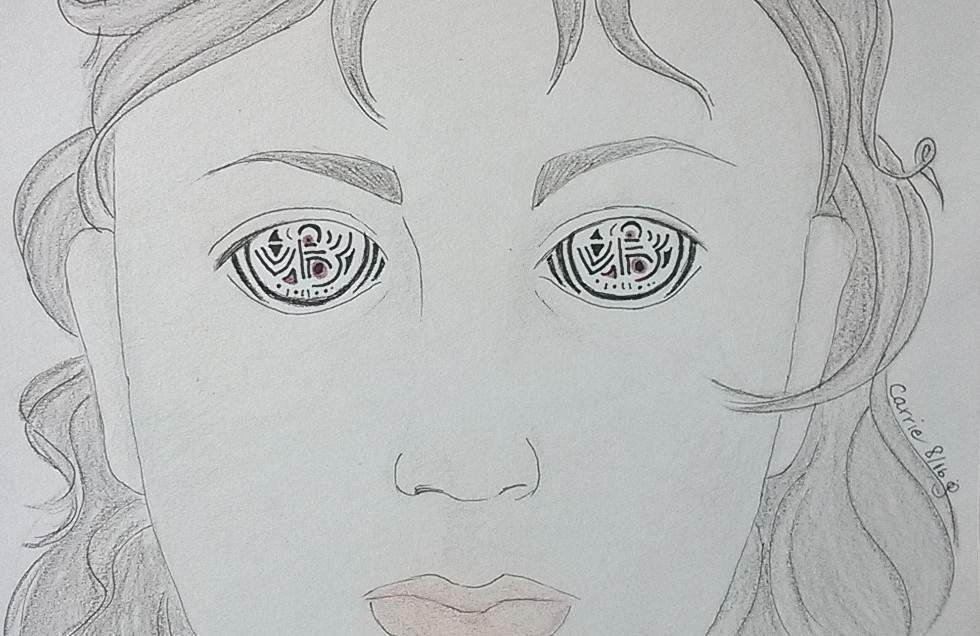
urchin.jpg
“Urchin” — C.Birde, 8/16


Break and Repeat — A Dream

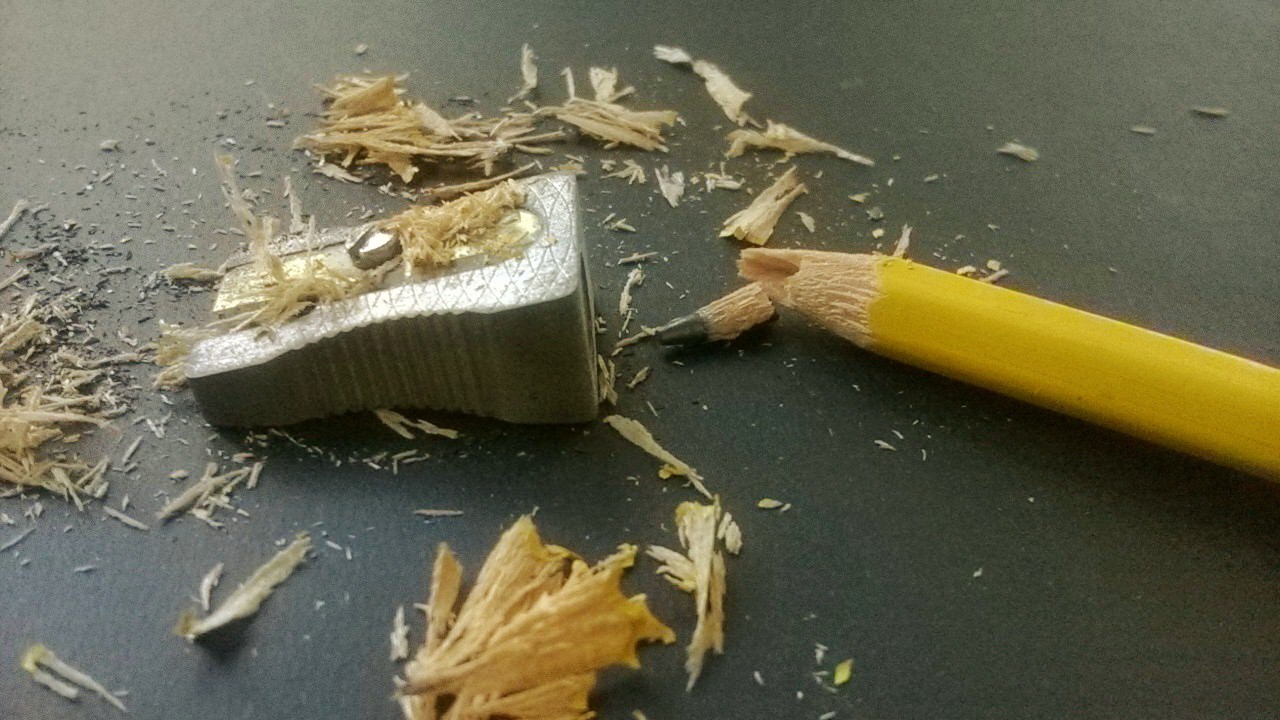
One hand holds a pencil — a slender, hexagonal length, sheathed in bright yellow paint; the other grips a sharpener — small, silver rectangle, the blade within angled inward over its hollow belly. Insert pencil into sharpener. Apply gentle pressure. Crank the wrist and twist repeatedly. Curls of yellow-edged wood peel away from the blade. Dust of graphite falls. Withdraw pencil. Touch sharpened tip. Though it pricks the index finger — indeed, leaves a gray dot smudged upon the whorled fingerprint — the point itself wiggles, falls away. Broken. Reinsert pencil. Twist and turn. Watch carefully as the graphite core is slowly exposed from beneath splintered cowl of wood. Observe as the tip breaks while sharpening. Withdraw pencil. Tap out sharpener to remove wood, and dust, and graphite tip lodged within the channel beneath that bright, slender blade. Reinsert pencil. Twist and turn. Extract pencil from sharpener. Touch tip. Sigh as point falls away. Repeat. Over. And over. And over…


Broken lead.jpg
“Break & Repeat” — C.Birde, 8/16

Friends Who Weren’t — A Dream

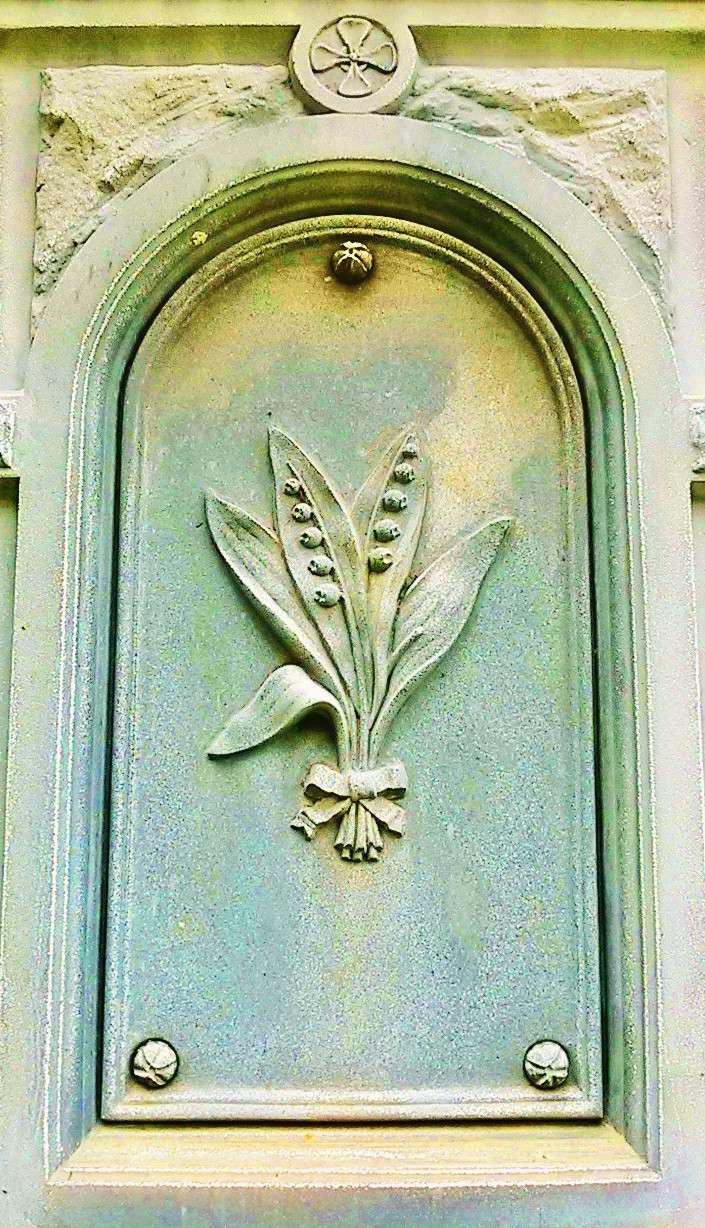
I walked with two friends. One brought her husband, the other arrived late. We met to climb the mountain, the path ever changing before us. Initially, our feet crunched over coarse gravel; we wore dappled green and honeyed  light as cloaks and crowns. Next, we walked through a parking garage, sparse of cars and curled with shadow. Finally, we stepped, single file, over a plush red carpet along a narrow aisle that moved in straight lengths, rose in flights of short steps, and turned at right angles through a museum. We passed glass display cases of antique devices — clocks and telephones and radios — until we reached a pair of sunken benches upholstered in red. Sinking into the benches, we sat together before an antique miniature pipe organ set against one wall. A marvel of construction, crafted entirely of  polished, glossy wood and bright brass, the organ was a thing of beauty…until it began to play. Its keys and pedals moved entirely on its own mechanized synchronizations, and the music that blared forth was discordant, cacophonous. Despite this, despite the path’s many mutations, one scene melting into another, the only aspect of the journey that grieved me was the realization that my two friends — who each were so dear to me — had nothing in common, shared no bond beyond me, myself. Unable to build any connection between them, they could only exchange wan smiles with one another before looking  away.


Lily of the Valley carving .jpg
“Lily of the Valley in Stone” — C.Birde, 8/18


Down — A Dream

Built within a natural cavern, this enormous, sub-terranean facility spreads as far as the eye can see, recedes into shadow. A vast metal structure is anchored to the ceiling far above from which depend industrial light fixtures strung at intervals from thick cables. Highly polished floors gleam bright white. The horizontal aspect is interrupted only by a handful of lectern-style stations scattered about the otherwise empty space. Uniformed workers in hard hats move between the stations to monitor them, adjusting dials and switches, pressing flashing buttons. Though my companion and I look utterly out of place in our jeans and t-shirts, the workers do not deviate from their tasks as we pass. Our footsteps throb and echo.

We soon reach the object of our search — a large free-standing structure that resembles a sleek, stainless-steel armoire. On closer inspection, I realize it is a free-standing elevator. My companion presses a raised button on a burnished panel, and the elevator’s thick glass doors slide open noiselessly. Once we have entered, my companion again presses another button. The doors seal shut, and the elevator begins its descent.  We head far, far below, to the facility’s power source — the heart of a nuclear reactor.

The elevator gathers speed with each second of its descent. Soon, my ears are filled with a faint “whooshing” sound. A dull red light begins to fill the downward shaft. I glance at my companion. He is silent, hands in his pockets, his gaze fixed above the glass doors to read the flash of numbers indicating our plunge. His apparent calm does nothing to alleviate my growing panic, which soon escalates to hysteria. Heart pounding, breath restricted, I spring at the burnished panel, indiscriminately punch buttons. When the elevator shudders and groans, interior lights flickering, I find the faintly luminous “up” arrow and lean the heel of my hand against it.

The elevator responds — agonizingly slowly. Reversing course. Beginning its initial ascent. Gathering speed. My panic is similarly slow to depart.


Down.jpg
“Down” — C.Birde, 7/16


Four Bears — A Dream

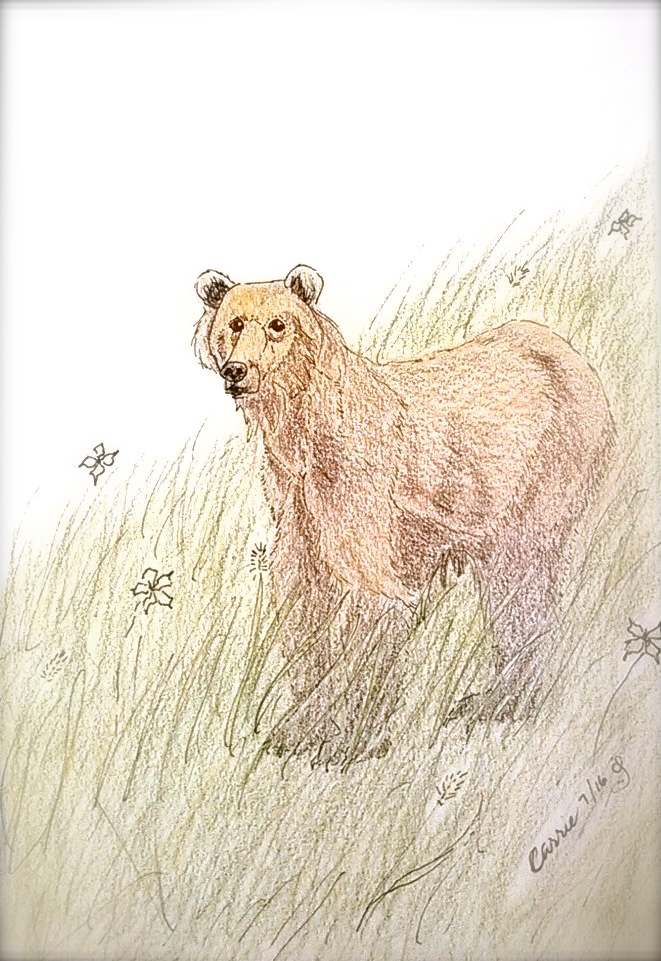
Neglect shrouds the bungalow. Abandonment. Crouched at the hill’s crest, the structure is slowly engulfed by a silent chaos of overgrowth and tangled tree shadow. From dark unpaned windows, beneath low-hanging eaves, the house peers vacantly down the hill. The air of neglect extends beyond the bungalow in a radial arc. Sere, unmown grass slopes down and away from its front door. Pale seed heads nod and bend, dip and shush with wind. Wildflowers, their petals blanched of color, float over the grassy sea like moths. And, standing chest-deep amidst this lawn-turned-meadow, are four scrawny bears. Arranged at equidistant points in a rough square, their coats are lank and straw-brown, and they are heartbreakingly thin. Their dark eyes consider me where I stand, far below, and then, as if they are a single unit, they begin to bend slightly at their wrists and ankles, flex at hips and shoulders in a pulsating fashion. They remain, otherwise, rooted in their paws, standing in the derelict lawn, staring. Eyes as wide and dark as the bungalow above them, grass and fur commingling, they stand and stare and pulse.

four bears.jpg
“Four Bears” — C.Birde, 7/16

Dreamlessness, Week #2 — A Truth

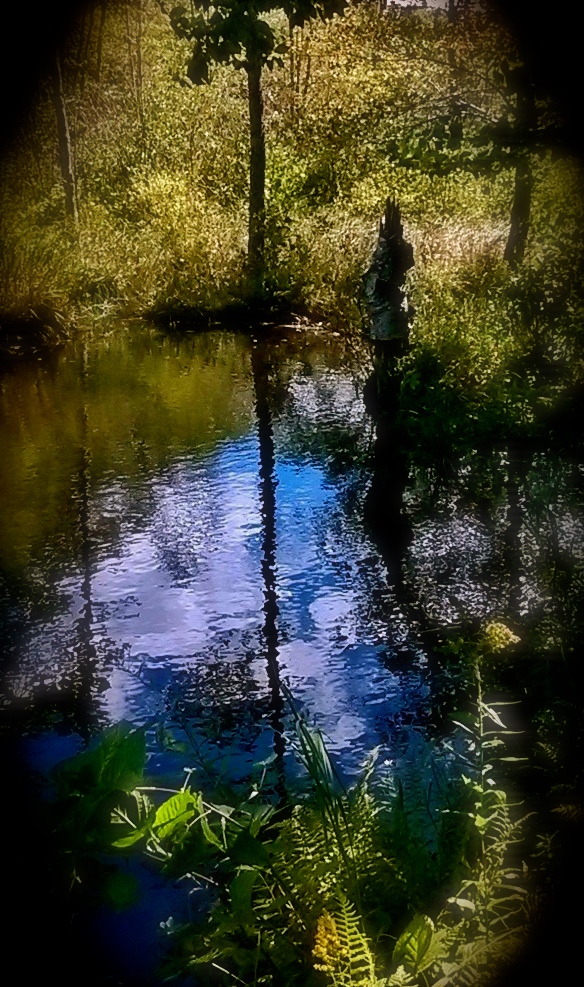
Though I try to assure retention, my dreamless state continues. It is as if I kneel at the water’s edge of dreams, shins and the tops of my feet pressed against damp and pebbled banks. Leaning forward, I peer into that fluid body to see what darting minnows, what tadpoles and frogs and crayfish might live and move within. Each flash of movement that draws my attention is quickly interrupted, disturbed — a shift in light alters reflections; waters’ surface ripples with wind; something stirs below to send up obscuring plumes of silt. And if I am fortunate enough to slip my hand into that reservoir — slowly — and close fingers about some small, mercurial thing — gently — it eludes my grasp. Withdrawing my hand, I find it has escaped as certainly as the water streaming from my spread fingers.


Dream reflection.jpg
“Dreamless Waters” — C.Birde, 7/16


Dreamlessness — A Truth


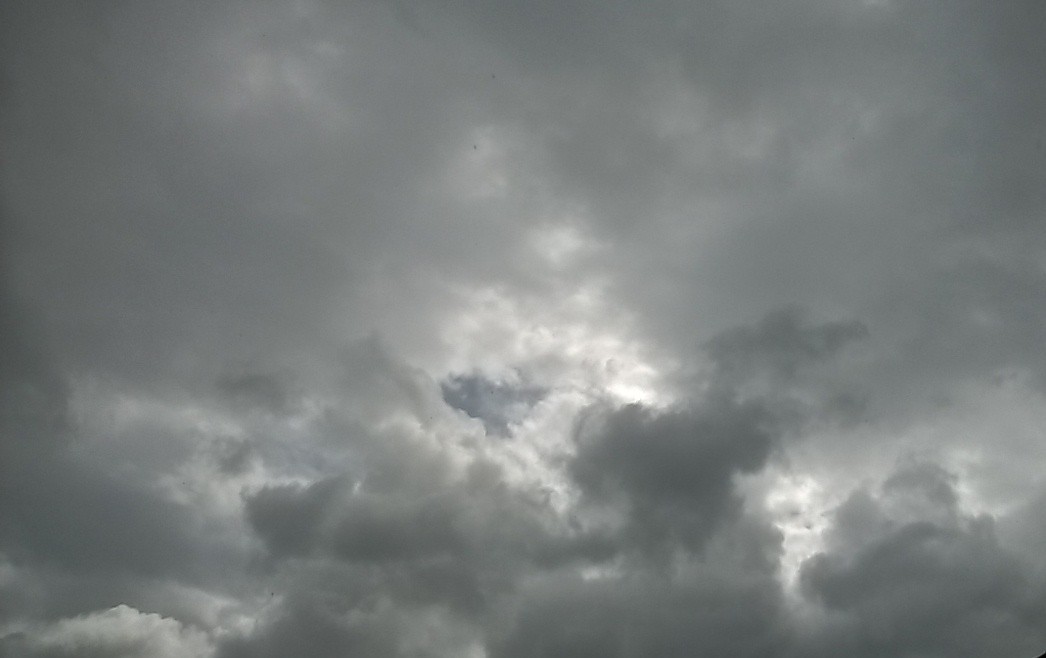
dark clouds.jpg
“Clouds of Dream” — C.Birde, 7/17

My dreams have taken on the aspect of clouds. I move within their certain uncertainty, the corner of my eye smudged with image, and emerge trailing vapors. Atoms of recall cling, but the whole vanishes, swallowed upon waking. And I am left to wonder and scrounge and rue the dream’s reabsorption.

Shift — A Dream

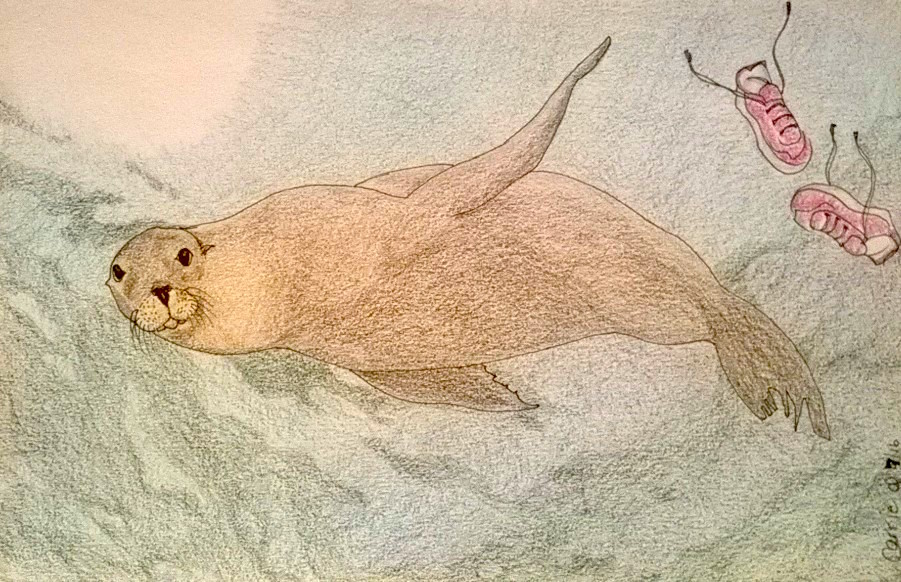
As far as the eye can see — water. As if the land itself has shifted its elemental nature, exchanged solid certainty for the mercurial, the mysterious. And he and I, adrift amidst it all.

Perched atop a dining room table, we float unmoored within a vast sea that stretches to all horizons. Wavelets slap the table, send small plumes and rivulets over its smooth surface. The formica top grows slick. I kneel within an ever-shrinking dry patch to one side of the table’s central seam. In contrast, he sits at the other edge, dangling his feet, with blue-edged water creeping over his knees.

Shins and knees squeaking on formica, I begin sliding down the dining table’s incline. Toward boundless water. Toward him, where he laughs and talks and splashes feet and hands, oblivious. But my incremental advance soon stops. Before my eyes, I see him shift, exchange his cumbersome human form for something sleeker, smoother, more well-suited to our surroundings. His clothes and shoes slip into the water, drift away on its currents as he glides off the table in his new form — a sea lion. Watching him dive and swim and roll, I laugh. This form suits him.  He suddenly makes complete sense to me.

Sea lion.jpg
“Shift” — C.Birde, 7/16

Devolution — A Dream

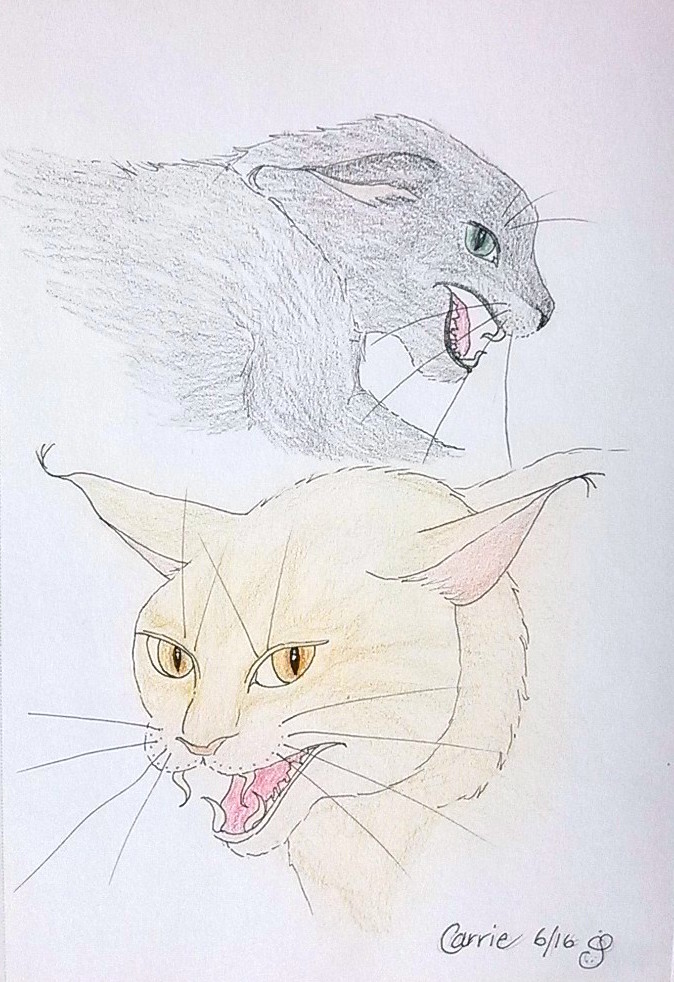
Slowly back away, out of the darkened house. Step carefully, toe-to-heel, toe-to-heel. Watch them skulk forward from the shadows. They advance with bellies low. Don’t break eye contact. Don’t trip as you move, don’t fall. They’ll pounce. They’ll tear and rend. They’re too far gone now — no calm words, no soft vocalizations will bring them back. They have devolved. No longer the sleek-coated creatures that, just yesterday, you ran your hands over, that lifted to receive your touch. They bristle. They hiss. Their ears and teeth and claws have elongated and begun to curl. Their jaws shift forward. Don’t look so closely. Don’t think about it. Ignore the rapid beat of your heart, the shallowness of your breath and sweat at your hairline. Continue your uncertain exit. Find the door at your back. Press into it. Feel the bite of wood, the chill handle beneath your groping hand. Hear the click of metal tongue, the creak and gasp of hinges. Back out — slowly, slowly — into the cool, heavy night. Quickly now, pull the door shut as they hurl themselves upon it. Hear them yowl and scream. Hear their talons gouge wood. Pause a moment to catch your breath, to collect yourself. You have escaped. Now, run.

Devolution.jpg
“Devolution” — C.Birde, 6/16


Stolen — A Dream

Where can it be? It can’t simply have disappeared. I kneel on the linoleum floor, press knees to worn brown and ocher and ivory tiles. Bending, stretching, I reach under the couch to probe carefully, all the while wondering, who puts linoleum in a living room? And who lives in this mess? I pull wadded articles from beneath the couch — old ragged blankets, tattered pillows. All is covered in thick clots of dust.

I do not find my purse. Wallet, cash, photos, ID — gone.

This place has an air of abandonment — cluttered and aged, forgotten. The air smells stale and still. After searching the living room, behind and beneath furniture and boxes and bookshelves, I walk down a narrow, shadowed corridor, up a steep flight of equally narrow stairs. The hall stretches on through murky half-light. At its end, a rim of light edges a plain door. I press it open, find a young girl in a small, cramped bedroom. She has glossy brown hair and tanned skin and sits, her legs tucked beneath her, on a tall bed. Although she is a stranger to me, I know, looking at her, that she is the one — the thief. She has stolen my purse.

A wave of anger boils up, shivering through me till I tremble. Who does she think she is? To steal from me? Steal my identityYell at her. Threaten her. Pick up the phone there on the wall, pretend to dial the police, fingers barely touching the keypad. Speak to the crackling, open line, explain the crime. (Hang up quickly when a man’s voice answers!)

But my implied threat has reached herShe is truly distressed, has risen to her knees on the bed, with hands clasped at her chest and fingers threaded in a gesture of pleading.

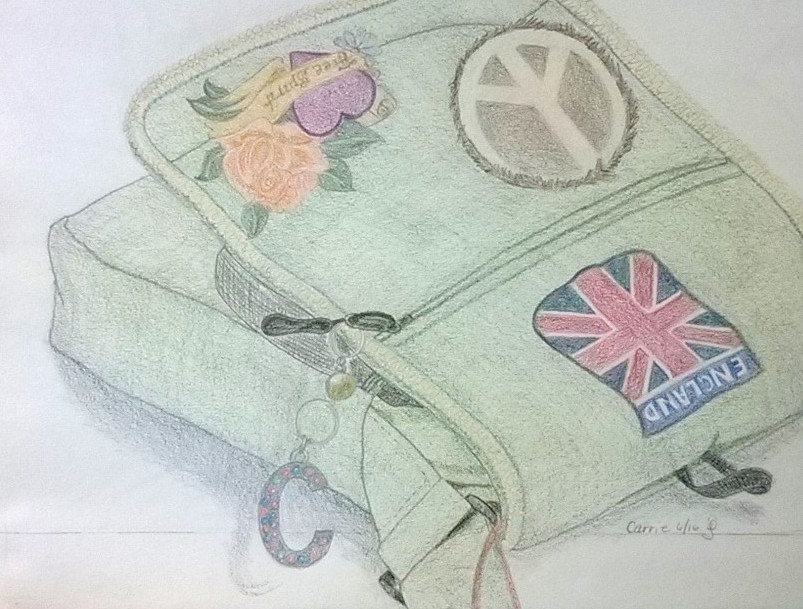
I insist she return my purse; at the very least, she must help me look for it. She nods frantic agreement while I describe it — olive green canvas with a peace sign patch stitched to its front. As I provide more detail, I feel a weight upon my shoulder, a pressure against my hip. Glancing down, I see the purse, my purse, slung across my chest from right shoulder to left hip. Completely baffled, I cannot understand how it has come to rest there when I have spent so much time hunting for it. When I look up again — to apologize, to call off the search — the girl has scurried away.

Stolen purse.jpg
“Stolen” — C.Birde, 6/16