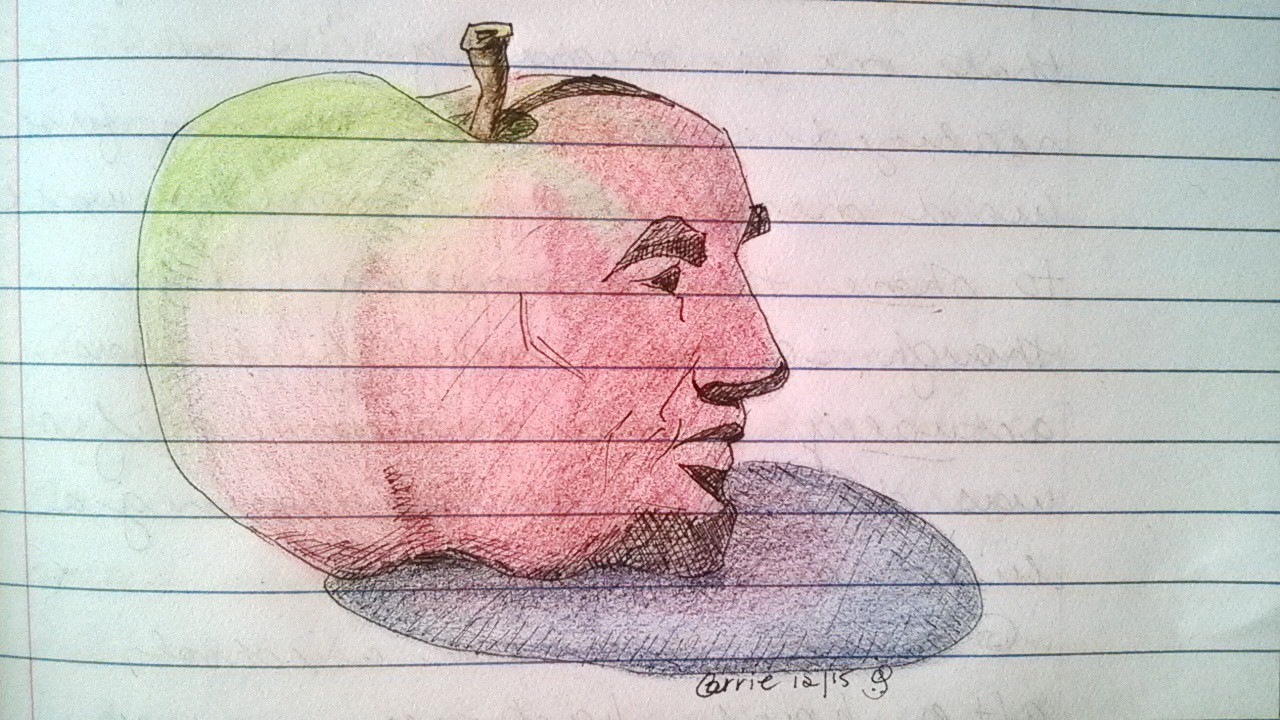
I’ve lost the apple, can’t find it any where. I describe it to them — such a remarkable apple! How could I have lost it? So unusual. Perfect in its imperfection. Though its one side was misshapen, the other held the profile of a man, of Abraham Lincoln.
“Is this it?”
He hands an apple to me. Can it be? the one I dropped and lost mere moments ago? Yes! The weight of it fills my palm. I hold the curve of crisp fruit in my left hand between thumb and forefinger, and turn it back and forth to behold again its remarkable shape.
But…it’s changing…losing its blush of red and green hues; softening beneath my fingers’ grip. Slowly, it reshapes itself into something fleshy, pallid, disturbing. No longer an apple, I now hold what looks like a shrunken, knobby head. A mashed face that sprouts mismatched ears. The narrow spaces behind those ears are filthy with crud. Beneath my fingers, the head moves and shifts and wriggles. Features still uncertain, it stares back at me with dark, bead-bright eyes. No longer a thing of wonder, it is now utterly repulsive.
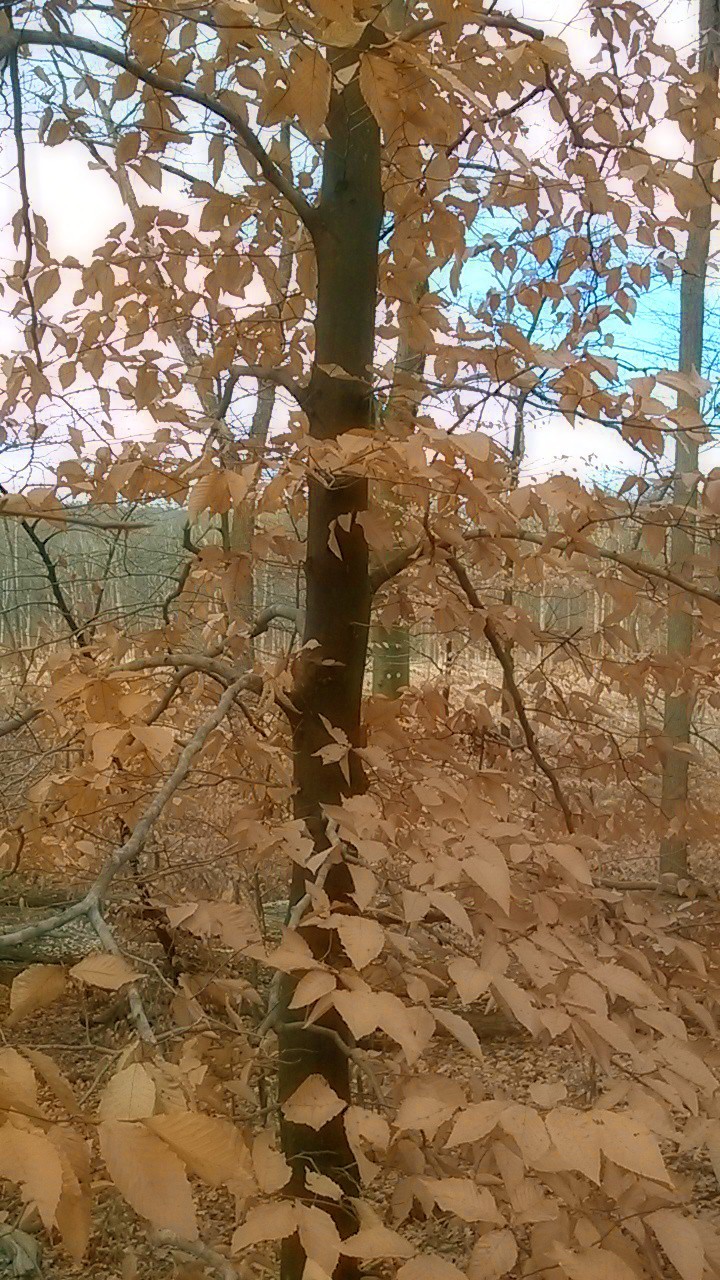
Merriam Oak has let go a sheaf of bronze-bright leaves, each as large as my booted foot, or larger. To walk beneath these bare and spreading boughs is to kick through a three-season journal, each leaf an entry, while the author prepares for rest and reflection during the spare Winter days to come.
The apartment is on the topmost floor of an old brownstone. If I stand on the landing and look over the railing’s edge, I can see the banister march its way down the stairs — at each landing, it curves sharply back on itself and creates a vertical, oblong tunnel all the way to ground level far below.
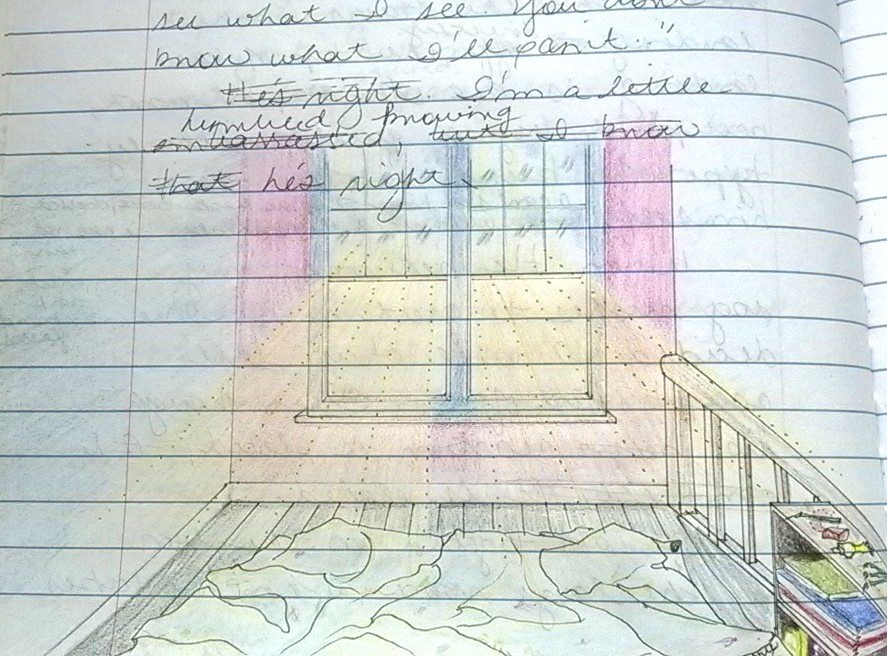
Having accepted his invitation to visit, I find myself in a large, open room that takes up the majority of this space — it must be fifty feet in length and twenty feet wide; the ceiling flies away into shadow overhead. Large drop cloths almost entirely cover the chipped but shiny black-planked floor. One long wall is painted a pale gray, and the room’s smaller, far wall is candy-apple red and inset with huge cobalt blue-framed windows that look out over the street below. There is no need for curtains so high up. Sunlight streams unobstructed through the great, wide panes of open glass. The dark wood banister defines the room’s other length, its railing all but obscured by random shelves thrust up against it. Shelf after shelf, filled with art supplies — single sheets of watercolor papers and great, thick pads in various weights and sizes; pencils, pens, paints, pastels; brushes; clay, plaster, canvasses.
I could be very happy here but am a little uneasy about becoming involved. He tells me he wouldn’t have invited me if he were in another relationship — he wants to commit. Silently, I study him — his face is mostly hidden by sleek, straight, dark hair fringing his cheeks and brow; but he is trim and lithe with smooth, tan skin, and a chin and sweep of jawline that suggest sensitivity. As I consider, my gaze moving over him, over this living space, he busily preps a canvass, stretching and securing it to a sturdy frame. There is utterly no tension in his body as he bends over his work, his movements graceful, assured. Without glancing from his task, he tells me the decision is entirely mine — to accept his proposal or decline. Completing the frame, he says he’ll give me a moment to consider, and rises, descends the staircase. I hear his feet pad softly down the steps.
Again, I look at this great, open, airy room, with its abundance of natural light and opportunity. Behind me, there is another closed room to the right of the wide landing. I open this smaller door to peer inside — it is an unfinished, small, and cozy space that would make a perfect bedroom. Stepping out again, my hand still resting on the door handle, I see another apartment opens directly off the top of the landing, occupied by a quiet, scholarly type who keeps mostly to himself. I catch a glimpse of him, his back turned toward me. He has short red hair and neatly trimmed beard and mustache; wears dark-rimmed glasses, blue plaid shirt and khakis.
When the artist returns, my little dog rushes happily to greet him. I realize I’ve made my decision. I will stay. I’ll accept his offer. Though he receives this news placidly, he is elated. Together, we sit on the floor in the large room. When he takes up a handful of brushes, chooses paints, collects his canvass, I lie down on my side to watch, my arm crooked beneath my head. I tell him I don’t like my picture taken — I don’t like my crooked tooth, my round-tipped nose. Quietly, he sets all his tools in his lap and says, gently but with challenge: “You don’t see what I see. You don’t know what I’ll paint.” I’m a little embarrassed. He’s right.
We walked this morning. Two bipeds, one quadruped, together breathing in a mild mid-morning.
“Rattlesnake Meadow” — C.Birde, 11/27/15
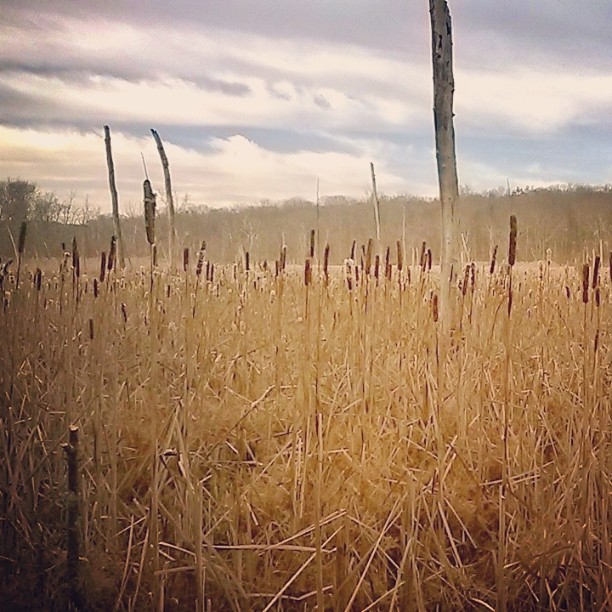
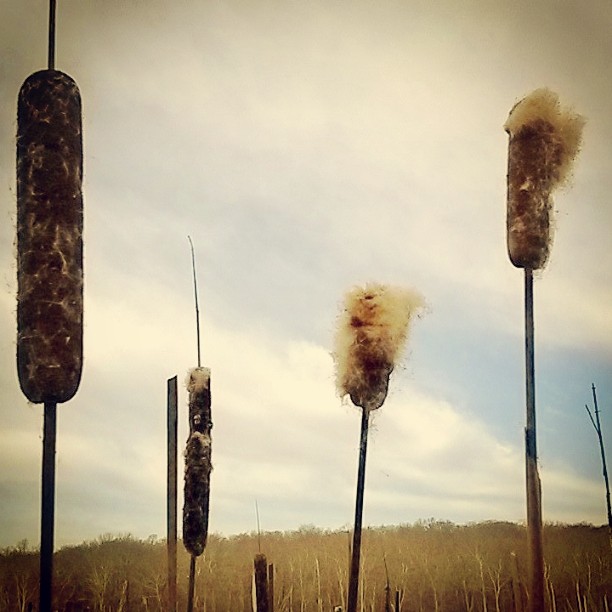
Rattlesnake Meadow flickered with a wind’s breath that slipped between blown cattails. Snowbirds tittered and darted with sparrows too quick, too subtle for my eye to name.
“Blown Cattails” — C.Birde, 11/27/15
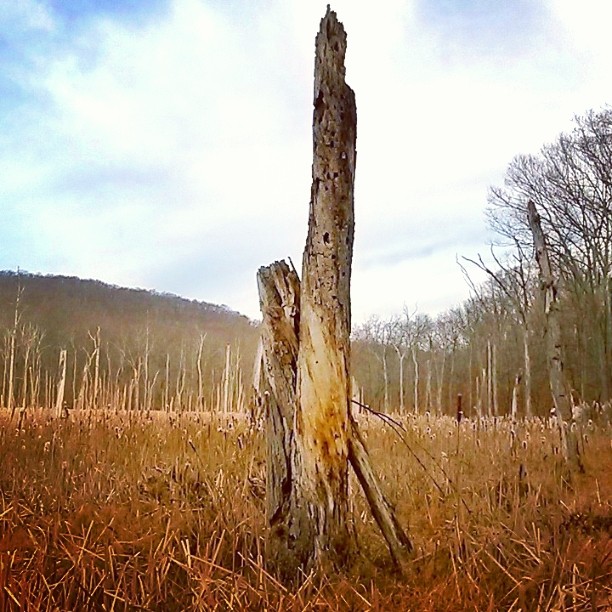
A Red-tailed Hawk skimmed the meadow’s reed-sawn edge to roost in a slow-decaying tree. Patient, he surveyed the landscape. So much hidden within those pale grassy blades — I missed the Snowy Egret; I’m certain he did not.
“Totem” — C.Birde, 11/27/15
At our walk’s end, a white-tailed deer wove ahead across our path, unconcerned by our intrusion. A fortunate start to a late-November day.
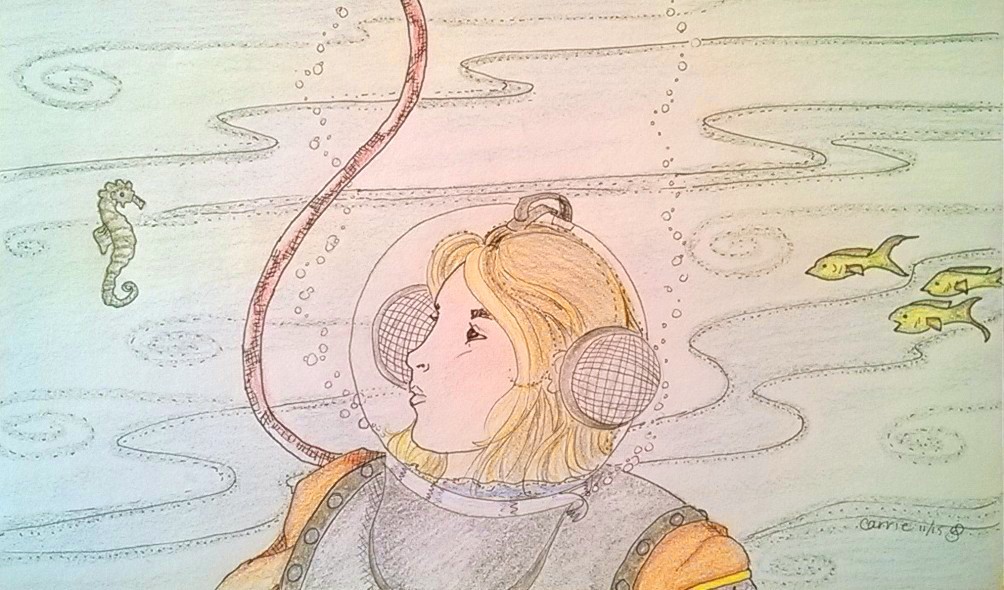
Water presses from all sides, a constant squeeze upon my dive suit. As old and worn as the suit is, the fish-bowl helmet affords unobstructed visibility in all directions. The ocean piled atop me is beautiful — serene, quiet, teaming with life. Craning my neck within the helmet, I watch minute bubbles spiraling up alongside my oxygen tube. Each snakes independently toward the surface through blue and green layers of sea.
My partner and I work together to examine a large pylon-like structure that thrusts from the ocean floor. Its antiquity is evident in the thick layer of barnacles crusting the object. Generations of anemones have settled upon it and wave opaque tentacles in the ceaseless current, while crabs scuttle expertly over its uneven surface. But the pylon needs attention and repairs. We’re uncertain what’s wrong with it and how we’ll manage restoration.
My more immediate concern, however, is the water leaking into my helmet — the Scotch tape seal has lifted and a slow rise of sea water climbs within the glass, lapping against my neck, my chin, my jaw. Ineffectually, I attempt to mash the tape back down, by my movements are slow and awkward. My hands, encased in heavy gloves, are poor instruments for such delicate work.
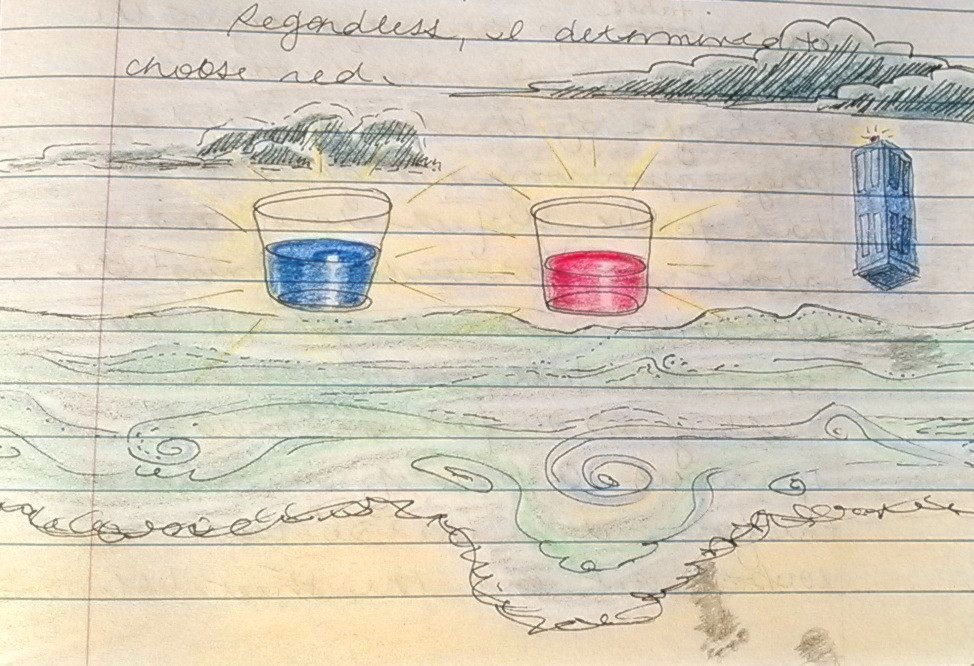
The gray sea stretches out toward the horizon beneath a vast, gray sky. Hovering over white-capped wavelets is a blue telephone box (yes, excruciatingly similar to the Tardis). Hands in pockets, shoulders hunched, a dark-clad man steps from the box and walks away across the sea without dampening the soles of his shoes. The phone box’s door gapes, moving back and forth with the wind and groaning against its hinges. And we, gathered on the shore and disheartened by his apparent failure, watch silently as he leaves us behind. Then, the sea begins to boil…
Two objects rise from the tossing, gray waters — one resembles a cross-section of large, white pvc pipe; the other, a rat’s nest of steel wool. These should be inanimate, harmless, simple detritus thrown up onto the shore; but they are some how alive and very, very hostile. They give chase, and we flee, stumbling over the sand in our panic.
Beyond a wind-whipped dune I see a Gothic, brownstone mansion pressed against the dull and flattened sky. I press forward, push open the double coffin doors and find myself in a large entry chamber — dark, carved wooden staircase and paneled wainscoting; rich burgundy area rug and stair-runner; William Morris-style wallpaper. At the hall’s far end, a doorway blushes with light. Upon entering, I find a throng of people in an impatient, disorderly line. Standing on a makeshift dais, a man exhorts those on line to “choose well”. He continues, saying that those with a pure heart, who are gentle and kind and good, will pick the correct elixir; whereas those whose hearts and wicked and harbor ill intent and greed will choose wrongly. Apparently, either life or death will result. At the foot of the dais are two cherubic children, each holding a small, clear plastic cup. One child offers a red elixir, the other blue (this time, excruciatingly similar to “The Matrix”). Beyond them, is another room, and I step out of line to peek and find a heavily-curtained, semi-dark room. Candlelight flickers over small groups of people gathered together in plush armchairs and couches, talking quietly. Little empty cups lay scattered about low tables, across the floor. Nervously, they await the results of their choice.
Leaving this scene, I return to take my place at the back of the line. This room has altered radically and now resembles a pharmacy, all sterile white aisles, floors, walls, shelves. As the line slowly inches forward, I have a sudden insight — it doesn’t matter which cup one chooses, that the liquid’s color, red or blue, is insignificant. Rather, the liquid itself holds the life-or-death-granting qualities and is merely colored afterward. The good will survive the drink; the wicked will not. As an individual awaits their outcome, the results are mistakenly ascribed to the liquid’s color by those witnessing.
Regardless, I determine that when my time comes, I shall choose red.
(Confession — I had this dream in mid-July. I don’t recall what was occupying my mind at that time, but it seems appropriate to post it on the platform-booted heels of Halloween.)
We have been warned — we deviate from the path at our peril. There is no other guarantee of safe passage through the graveyard. Night and gloaming surround. Elongated shadows arch themselves over hillocks of drifting snow, but I easily find the sinuous depression winding through that indicates safety. I tell my son and husband to remain close, and then push through the frosted crust, breaking a trail. No sooner have we begun, than my husband has stumbled off the trail into deep snow. Alarmed, I call out, my voice hissing, and although he returns quickly, it’s too late. A distant howl of pursuit echoes, hollow and eerie, growing ever closer. The zombies are deceived neither by speed nor misstep.
With increased determination, I push through the snow. The path leads past neatly arranged headstones and down a cleft. Walls of snow rise up on either side of us as we descend steps hewn from ice-rimed stone. At the staircase’s bottom, a large chamber opens before us — at its far end is a scaffold beneath which spills an enormous quantity of foam peanuts and lint-like packing materials. I instruct that we must bury ourselves from sight within them, so the zombies will not scent us. My son and I are successful, but my husband does not sufficiently bury himself — his right elbow and side remain exposed. The zombies drag him out. I cannot see, but I hear all.
In the chaos, my son and I escape. We swim beneath the sea of packing peanuts and emerge in a narrow, worked-stone hallway which opens into another rectangular chamber. One third of this room’s length is galleried, raised several feet higher than the rest. In the gallery, poised over a large cauldron and gesturing dramatically, is a wild-haired mad-scientist. I warn my son to look away, that he must not linger, must not approach the mad scientist, but I am distracted. To my elation, my husband has returned and appears remarkably unaltered by his zombie encounter. Meanwhile, my son is unable to overcome the mad-scientist’s compulsion and has stepped up into the gallery. He is immediately transformed into a vampire. Rushing forth from the gallery, he vaults the stone railing to attack a woman — my sister?! — at the chamber’s far end. They collapse in a heap on the floor near a low dais upon which rests a closed, black coffin. My son-turned-vampire attempts, inexpertly, to bite. I must do something…must act…but I cannot. I cannot strike out because the vampire is my son, whom I love. The scene plays out like bad fiction until my surroundings slowly begin to tilt and revolve around me.
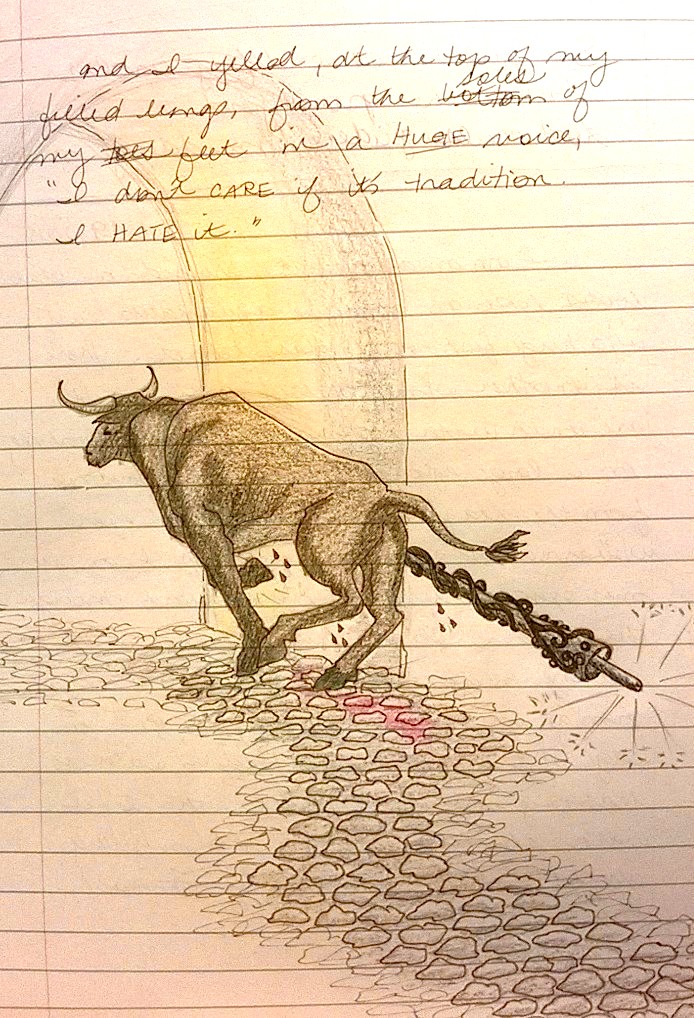
I peer through a square pane of glass, smudged at the corners with grit. This lends the scene below an antique character — curving, cobbled streets, damp from a passing shower; tall, sun-washed buildings leaning shoulder to shoulder. I realize I am in Pamplona, and an image in sepia tones appears before my mind’s eye, crowding out all else — a photo that has not yet been taken, of a bull being speared. The great creature’s body has been captured as it rears up, front hooves churning air, head and horns twisting leftward. A long, black lance-like spear thrusts from the bull’s right side body.
For a moment, I wonder how the photographer could manage to take the photo without being trampled himself. I speculate as to a structure that might be placed in the street’s center to protect the photographer on three sides when the runners and the bull arrive, and thus divert the tide of violence to pass around while affording an incredible view of the spectacle.
Suddenly, all is noise and chaos. I press my cheek to the glass. Surrounded by waves of people, the very bull I had foreseen in the photo runs past my cropped, squared-off view. Mud rises from the street in clots. Feet and hooves pound. The bull bellows, the men shout. From my vantage, I see a man below and to the right — he pauses at the fringe of commotion. In his hands is a great, black lance decorated lavishly with twists and coils vining from the hand guard down the lance’s length and diminishing upon reaching the weapon’s smooth, elongated tip. The man hefts the lance, draws his arm back in an impossible arc, and hurls the lance forward. It strikes first the cobbled street at an acute angle, sending up glittering sparks, then ricochets up to impale the charging bull squarely beneath its right front shoulder. The bull bellows rage and pain as the lance wags against its side body.
I find myself whisked from my lofty vantage and planted in the middle of the street behind the final wave of berserking humans who are thrilled at the sight of the bull’s shed blood. Within me, I feel a great pressure building from the soles of my feet, rushing upward to fill my lungs, until I am shouting. My voice is huge: “I don’t care if it’s tradition. I HATE it.” I do not feel as though any one has heard me.
Sleep. Heavy as guilt, heavy as duty. It swamps. It suffocates. It rests like a great weight, pressing upon me so that I cannot think, rise, lift an eyelid. I see myself on the narrow bed, in the small cabin I share with several friends, with my boyfriend. They tried to wake me, and I struggled to oblige but could not force my way to waking. The effort had me rolling off the bed, falling to the floor in a tangle of sheets and blanket, where I remain, submerged in sleep.
My friends move about the cramped cabin space gathering objects — towels, buckets, hats. They are concerned for me, but the ship has reached port and docked. They have places to go, things to do; they are eager to go ashore. I cannot tell them it’s okay, leave me; I’ll simply sleep. Out of a sense of guilt or responsibility, one of them calls the ship’s physician, who arrives promptly. Instead of examining me, however, the doctor proceeds to massage my boyfriend. I see all through the narrowest slit of my eyelids, through the lattice of eyelashes. He lies face down on the bed opposite me, and she has straddled his back, leaned in close, hands upon his shoulders, head dipped low enough to whisper in his ear. What does she say? He smiles, oblivious to her aims, to my neglect. I cannot voice my upset.
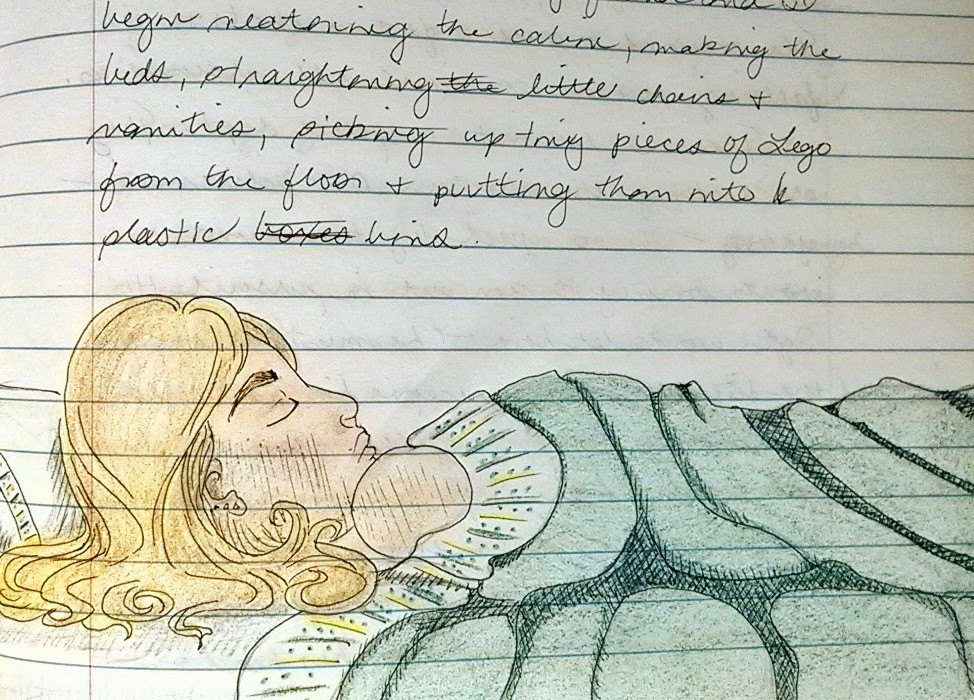
They leave — my boyfriend and the others. As the door closes softly on their exit, I realize one friend remains. She elects to stay behind with me, to watch over me. In my heap of blankets and inert limbs on the floor, I am overwhelmed with silent gratitude. My friend can’t lift me, so she grasps the tangle of blankets, drags me to the cabin’s center. She talks to me, encourages me to wake, demands that I wake. She shakes my shoulders, gently at first, then with increasing agitation and insistence. She slaps me. It stings. I want her to stop, to leave me alone. In frustration, she looks away…and must recall the fairy tale of “Sleeping Beauty”. Slowly, she turns and regards me for a long moment. I see decisiveness flicker in her eyes. Even in my sleep-slurred state, I feel a prick of alarm. She unbuttons her blouse, puckers her lips, and leans over me…and, to our mutual surprise, I manage to emerge from labyrinthine slumber before she can kiss me. I’m uncertain if she is as relieved as I.
Although I am now awake, I am far from alert — a fog fills me, edges my peripheries. My dutiful friend begins to neaten the cabin. She gathers the drift of linens from the floor, remakes beds, straightens dressers, table and chairs. Kneeling on the floor together, we pick up tiny pieces of Lego and return them to rigid plastic bins. Neither of us speaks.