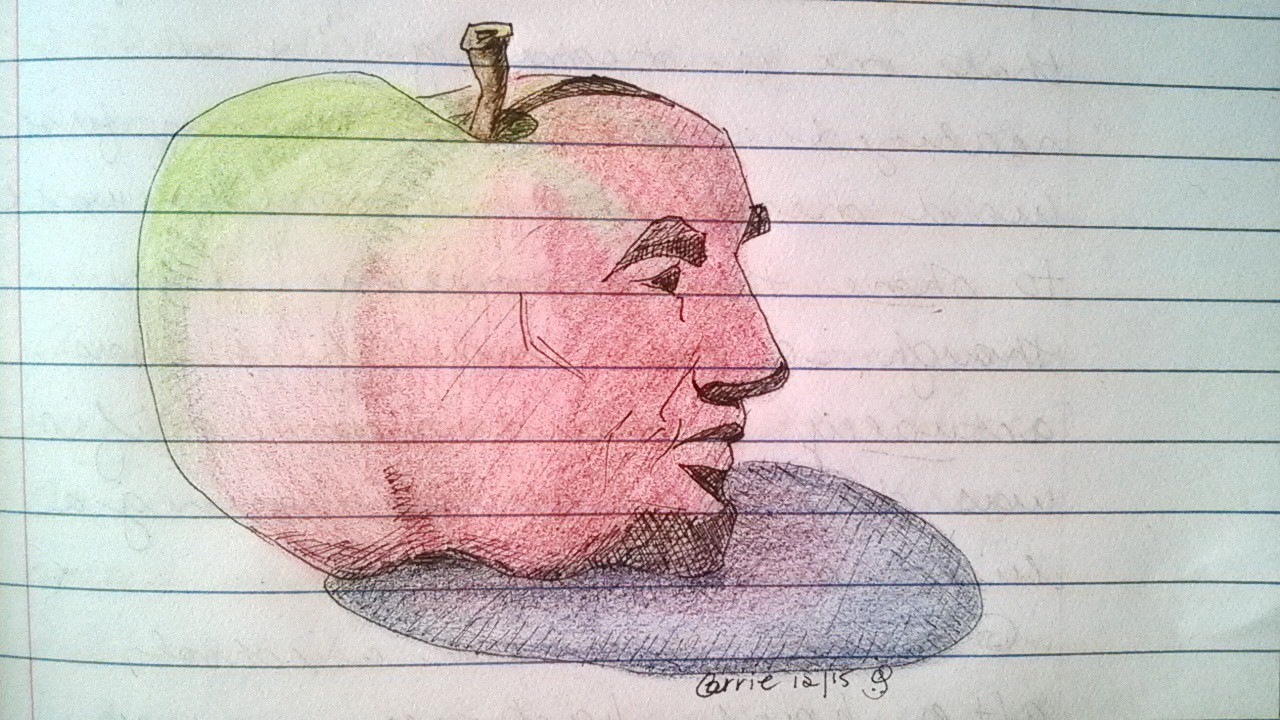
I’ve lost the apple, can’t find it any where. I describe it to them — such a remarkable apple! How could I have lost it? So unusual. Perfect in its imperfection. Though its one side was misshapen, the other held the profile of a man, of Abraham Lincoln.
“Is this it?”
He hands an apple to me. Can it be? the one I dropped and lost mere moments ago? Yes! The weight of it fills my palm. I hold the curve of crisp fruit in my left hand between thumb and forefinger, and turn it back and forth to behold again its remarkable shape.
But…it’s changing…losing its blush of red and green hues; softening beneath my fingers’ grip. Slowly, it reshapes itself into something fleshy, pallid, disturbing. No longer an apple, I now hold what looks like a shrunken, knobby head. A mashed face that sprouts mismatched ears. The narrow spaces behind those ears are filthy with crud. Beneath my fingers, the head moves and shifts and wriggles. Features still uncertain, it stares back at me with dark, bead-bright eyes. No longer a thing of wonder, it is now utterly repulsive.
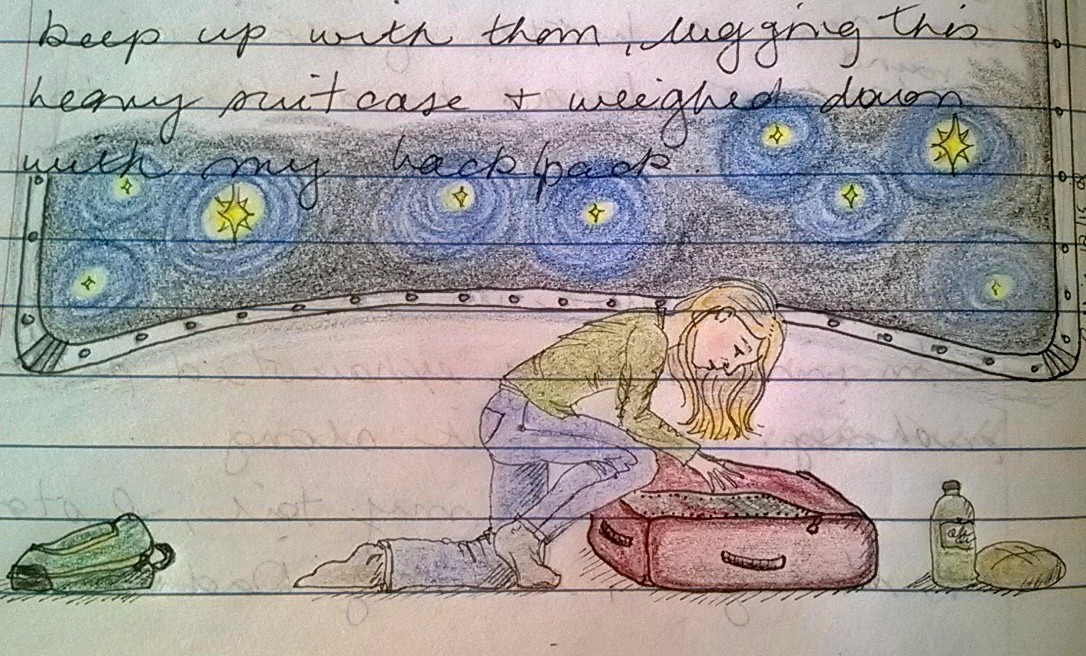
Beyond the panoramic viewing window, a multitude of bright stars pricks the vast, dark expanse of deep space. I see no planets, nothing that resembles Earth — the space station faces outward, not home. It would be comforting, reassuring to see Earth in its expected place. Then again, it could prove nerve-wracking, making all too apparent the hollow, coiling tube that stretches, like an umbilical cord, from the station all the way back to Earth. The tube through which I’ll travel with the others on my return trip. My visit here is over. I’ve seen the old man — he does not look well; his death is a lingering and protracted affair that none of us has enjoyed. But I’ve paid my respects and am scheduled to leave.
So I pack my bags — a small suitcase, a backpack, my purse. Fitting everything in is impossible — my unbound novel in its orderly collection of inch-thick sheets of paper; dictionary; thesaurus; the two books I’m reading. Fortunately, my Mom happens by, sees me struggling to zip the suitcase shut. She offers to help, and I pull out a bottle of olive oil and a round loaf of bread and hand them to her; I keep the bag of pretzels — my son may want them. Now, the case closes, but it’s still so heavy. I’m immediately exhausted pulling, pushing, tugging it along.
For a moment, I pause in my toil to stand and stretch, and, thus, see my Dad. Tall, straight backed, trim — he looks great, like he did years ago when I was a kid. And he’s smiling. An honest-to-goodness, ear-to-ear grin. I tell him how good it is to see him smiling and happy.
But I have to go. Mom leads me to the departure point, where a group of fleet, slim, tall guides wait to lead me to the coiling exit tube. My guess is that the guides are from sub-Saharan Africa — they are well-prepared for an endurance trek. I have no idea how I’ll keep up with them, weighed down by my burdensome suitcase and backpack.
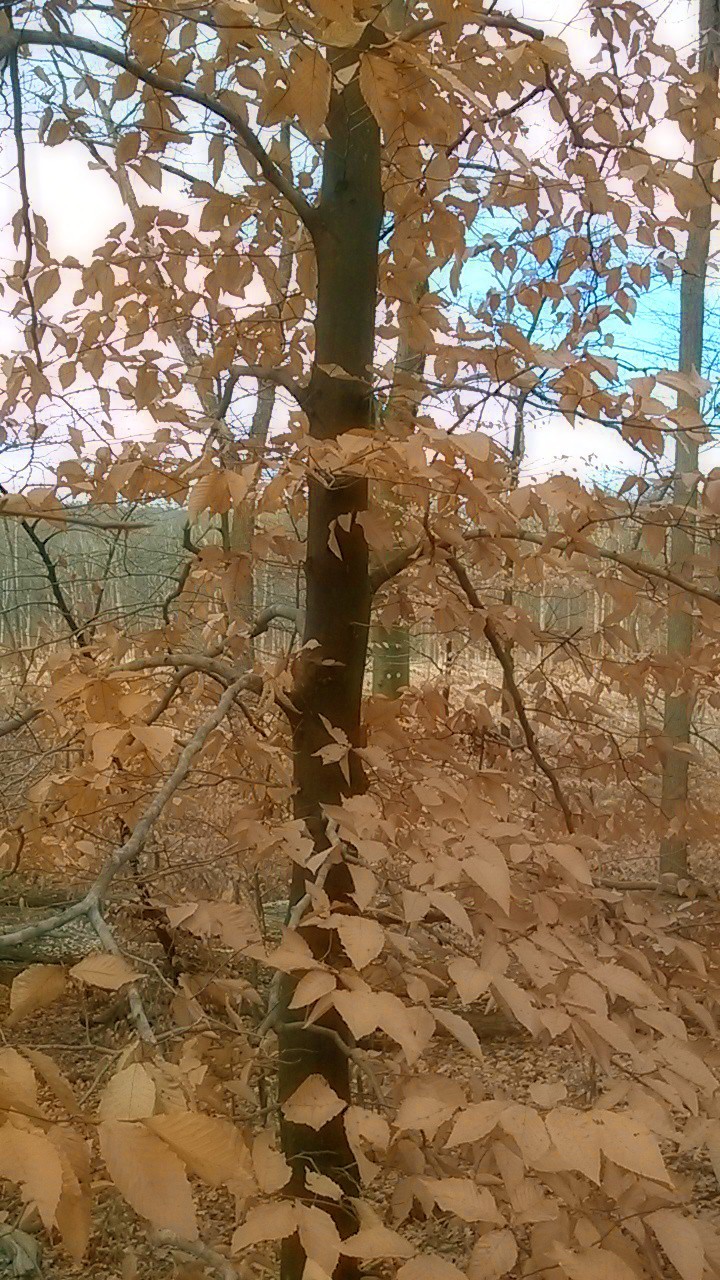
Merriam Oak has let go a sheaf of bronze-bright leaves, each as large as my booted foot, or larger. To walk beneath these bare and spreading boughs is to kick through a three-season journal, each leaf an entry, while the author prepares for rest and reflection during the spare Winter days to come.
The apartment is on the topmost floor of an old brownstone. If I stand on the landing and look over the railing’s edge, I can see the banister march its way down the stairs — at each landing, it curves sharply back on itself and creates a vertical, oblong tunnel all the way to ground level far below.
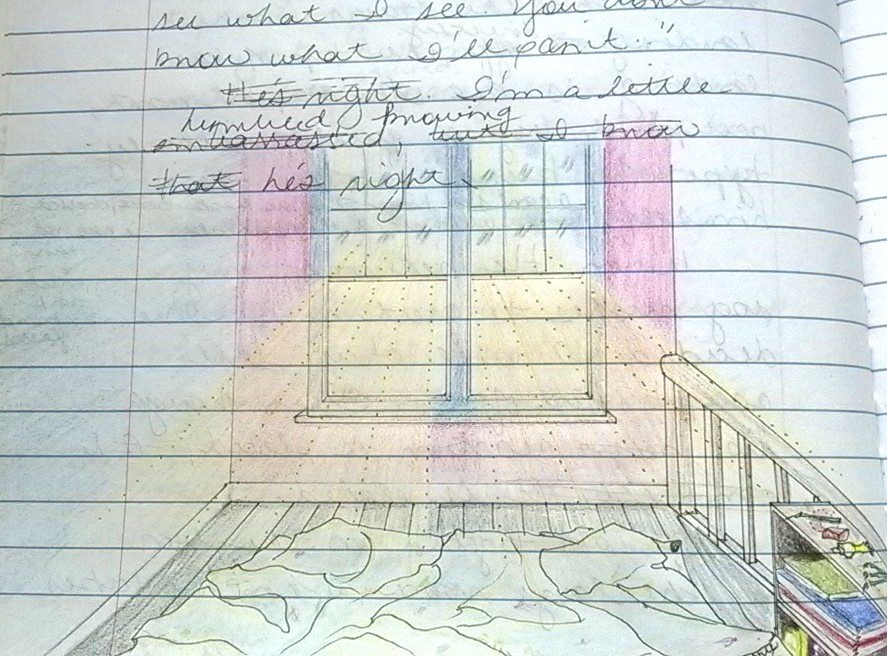
Having accepted his invitation to visit, I find myself in a large, open room that takes up the majority of this space — it must be fifty feet in length and twenty feet wide; the ceiling flies away into shadow overhead. Large drop cloths almost entirely cover the chipped but shiny black-planked floor. One long wall is painted a pale gray, and the room’s smaller, far wall is candy-apple red and inset with huge cobalt blue-framed windows that look out over the street below. There is no need for curtains so high up. Sunlight streams unobstructed through the great, wide panes of open glass. The dark wood banister defines the room’s other length, its railing all but obscured by random shelves thrust up against it. Shelf after shelf, filled with art supplies — single sheets of watercolor papers and great, thick pads in various weights and sizes; pencils, pens, paints, pastels; brushes; clay, plaster, canvasses.
I could be very happy here but am a little uneasy about becoming involved. He tells me he wouldn’t have invited me if he were in another relationship — he wants to commit. Silently, I study him — his face is mostly hidden by sleek, straight, dark hair fringing his cheeks and brow; but he is trim and lithe with smooth, tan skin, and a chin and sweep of jawline that suggest sensitivity. As I consider, my gaze moving over him, over this living space, he busily preps a canvass, stretching and securing it to a sturdy frame. There is utterly no tension in his body as he bends over his work, his movements graceful, assured. Without glancing from his task, he tells me the decision is entirely mine — to accept his proposal or decline. Completing the frame, he says he’ll give me a moment to consider, and rises, descends the staircase. I hear his feet pad softly down the steps.
Again, I look at this great, open, airy room, with its abundance of natural light and opportunity. Behind me, there is another closed room to the right of the wide landing. I open this smaller door to peer inside — it is an unfinished, small, and cozy space that would make a perfect bedroom. Stepping out again, my hand still resting on the door handle, I see another apartment opens directly off the top of the landing, occupied by a quiet, scholarly type who keeps mostly to himself. I catch a glimpse of him, his back turned toward me. He has short red hair and neatly trimmed beard and mustache; wears dark-rimmed glasses, blue plaid shirt and khakis.
When the artist returns, my little dog rushes happily to greet him. I realize I’ve made my decision. I will stay. I’ll accept his offer. Though he receives this news placidly, he is elated. Together, we sit on the floor in the large room. When he takes up a handful of brushes, chooses paints, collects his canvass, I lie down on my side to watch, my arm crooked beneath my head. I tell him I don’t like my picture taken — I don’t like my crooked tooth, my round-tipped nose. Quietly, he sets all his tools in his lap and says, gently but with challenge: “You don’t see what I see. You don’t know what I’ll paint.” I’m a little embarrassed. He’s right.
We walked this morning. Two bipeds, one quadruped, together breathing in a mild mid-morning.
“Rattlesnake Meadow” — C.Birde, 11/27/15
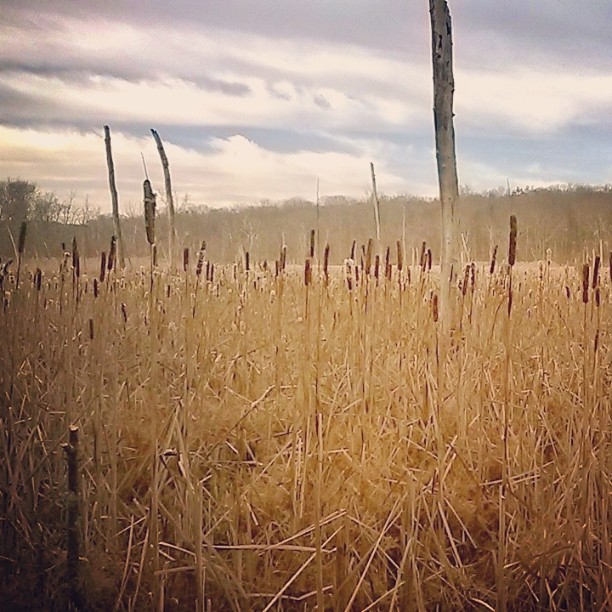
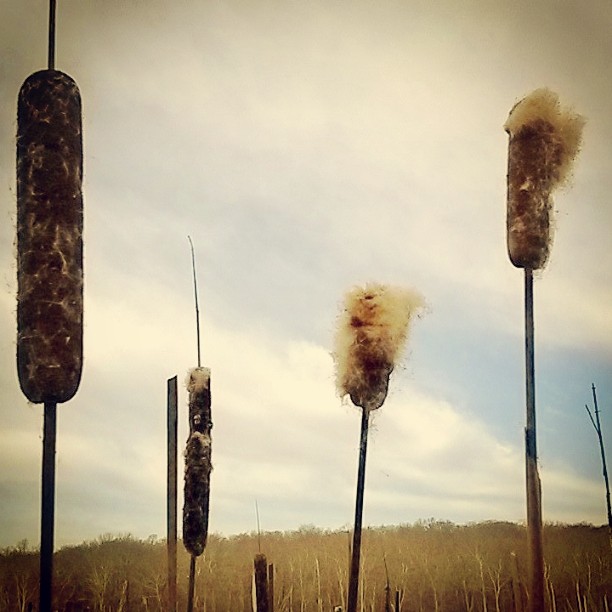
Rattlesnake Meadow flickered with a wind’s breath that slipped between blown cattails. Snowbirds tittered and darted with sparrows too quick, too subtle for my eye to name.
“Blown Cattails” — C.Birde, 11/27/15
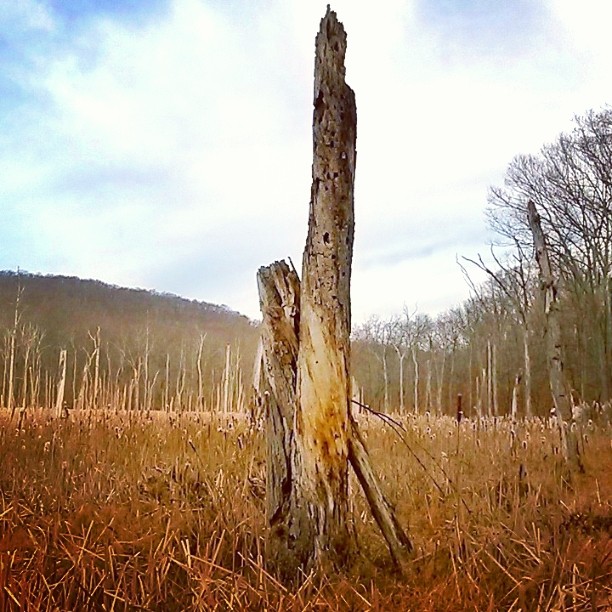
A Red-tailed Hawk skimmed the meadow’s reed-sawn edge to roost in a slow-decaying tree. Patient, he surveyed the landscape. So much hidden within those pale grassy blades — I missed the Snowy Egret; I’m certain he did not.
“Totem” — C.Birde, 11/27/15
At our walk’s end, a white-tailed deer wove ahead across our path, unconcerned by our intrusion. A fortunate start to a late-November day.