
The Sweetgum’s cache of seed pods are heaped upon the earth in offering. Each burlike sphere contains two small seeds. Each seed retains the bright green, star-leafed memory of its parent, and all of its potential.

The Sweetgum’s cache of seed pods are heaped upon the earth in offering. Each burlike sphere contains two small seeds. Each seed retains the bright green, star-leafed memory of its parent, and all of its potential.
The church hall is thronged — a mass of people sitting on the green-and-ivory tiled floor, all facing the stage at the room’s far end. From the back near the kitchen, my vantage allows me an unobstructed view of restless crowd, allows me to see the one, large man lumber to standing. Slowly he turns, his gaze settling on me. His face breaks into a great, goofy grin as he begins pushing his way through the crowd.
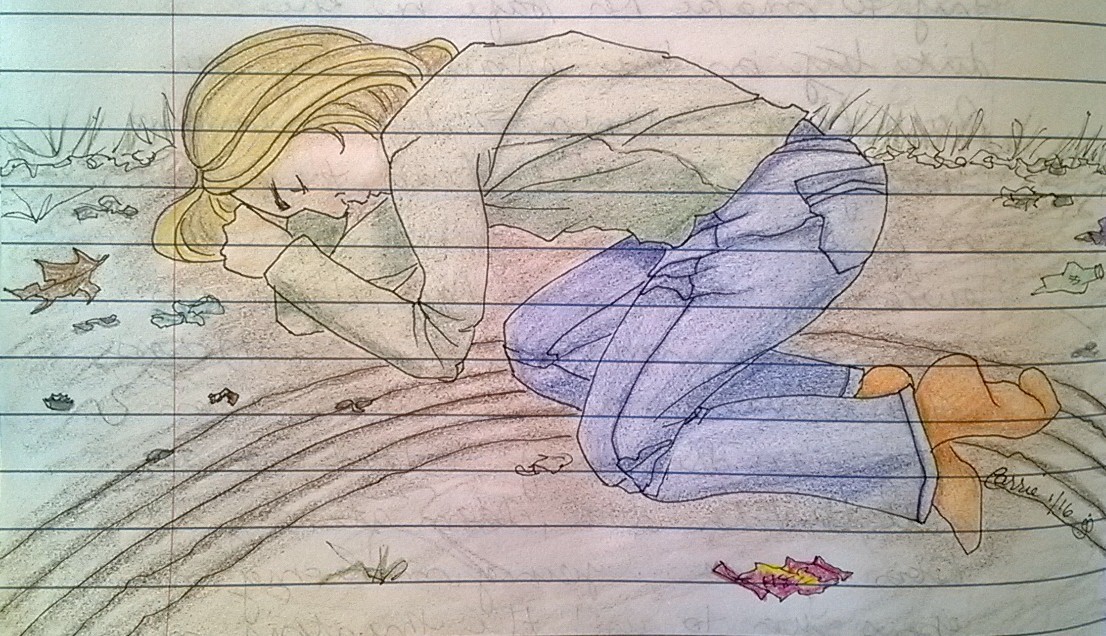
No, no, no. I do not have time for this — for his ridiculous games and bad jokes and awkward conversation. I make my escape before he can reach me. Past the coat rack, out the double doors, down the spill of wide steps into the night. To discourage pursuit, I dash across the street, in search of a place to hide. The night is cool and thick with shadow. As I prowl about, I’m concerned someone will mistake me for a burglar. Dogs in my grandmother’s yard raise an alarm. Heading back toward the street, I lie down in the dirt, curling up at the road’s edge. Grit and stones and leaf litter press into my palms, my cheek. Bits of broken glass wink and glitter, lit by passing cars’ headlights. The earth’s chill slips up into hip and shoulder.
When the footsteps approach, I peeking through my lashes, see a little girl dashing across the church’s night-darkened lawn. She can’t be more than eight years old — curly blonde ringlets, blue eyes. Dressed in a flounce of blue and white taffeta, a sky blue ribbon in her hair. Without hesitation, without a look, she skips across the street to lie in the dirt alongside me. Where are her parents? Why is she out here, all by herself, at this late hour? Traffic has increased now, and I worry about her safety, assure myself she is far enough away from the pavement’s crumble.
Checking on her again, she is no longer a little girl, but a young man who regards me with a steady, dark-eyed gaze. There is something menacing about him, predatory. On knees and elbows, I press myself up from the cold, hard earth and run back across the street, down the church’s long driveway. My husband awaits me outside the church’s side door; we’ll enter together, get back into the warmth and safety of the kitchen. But the door is flung open, and that same young man now blocks our entry. He threatens. Commands. Coerces. But I will not be influenced; will not be persuaded or manipulated. Until he changes his tactics, threatens instead to break my husband’s legs if I do not comply…
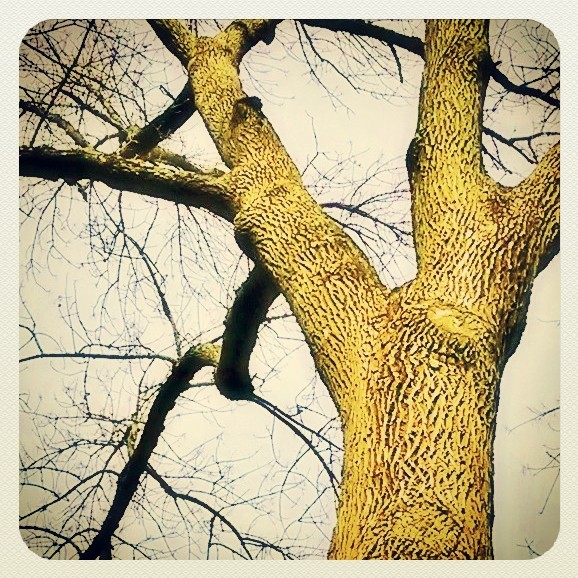
In Greenwood Cemetery, the White Ash lifts sinuous limbs, etching the flattened plate of January sky.
Surely, it would have been easier to enter the house from the ground floor, but then, she would have been aware that I was here. So, naturally, I’ve come in through a little door in the roof. Having gained entry to the attic, I can descend through the body of the house, undetected, at my leisure. Floor by floor, I creep through various rooms, sprinkling a trail of perfume as I go. The scent is woodsy and subtle, with hints of moss and musk — a favorite of mine. She’ll know I’ve visited, even though she won’t have seen me. My cleverness amuses me…
Until I realize the splashes of perfume I toss here and there — over pillow and bedspread, on couch and chair — exit the vial in thick wave of viscous blue. To my chagrin, I realize I’ve left an indelible, inky trail to mark my passage. My fingertips are stained, and the perfume bottle drips midnight behind me.
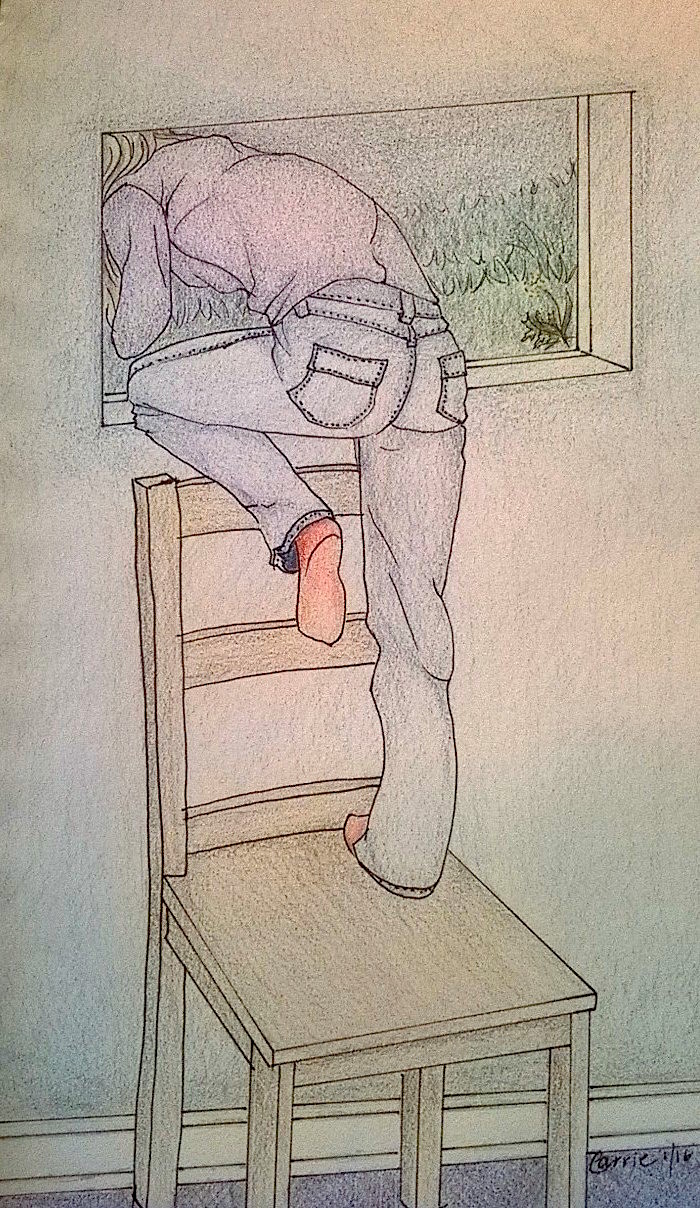
A clatter of noise echoes up from below as my friend moves busily about her kitchen. Feeling like a vandal, I edge down the stairs to the basement with my back pressed to the wall. I hope to leave unseen, but am not so fortunate — when I reach the finished basement, two men turn at my tread. They are middle aged, and one is my friend’s husband who greets me with cheery surprise. He offers me a drink, immediately includes me in the conversation. But I can’t stay, must leave. Crossing the room, I climb a chair situated against one wall and haul myself out a small window set high above it. Grass under my hands and knees as I duck the window’s low edge and escape into the night.
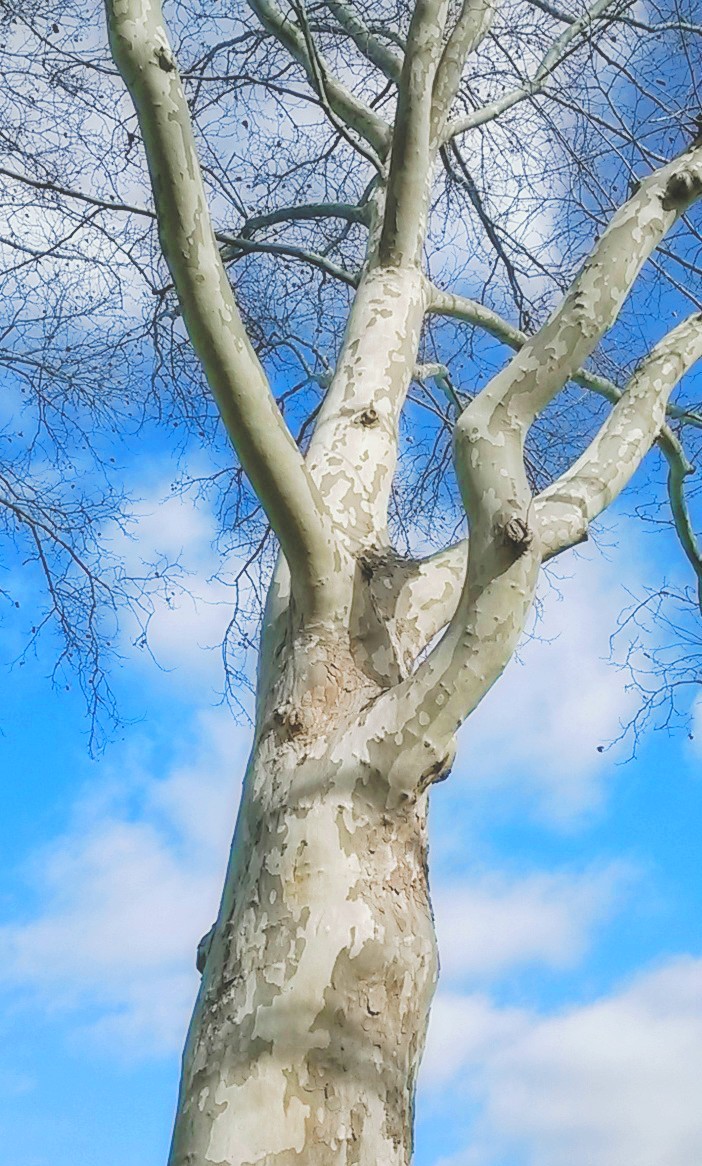
The Sycamore’s distinctive and mottled skin is beautifully revealed once its leaves have drifted free. Often, I walk past this tree and its siblings, and have seen the trio clothed in Spring’s green and festooned with compact pom-pom seedpods. In Summer, they shed like snakes, curled sheaths of bark accumulating in the grass at their feet. But I think they might be most striking when plucked bare by Winter’s touch.
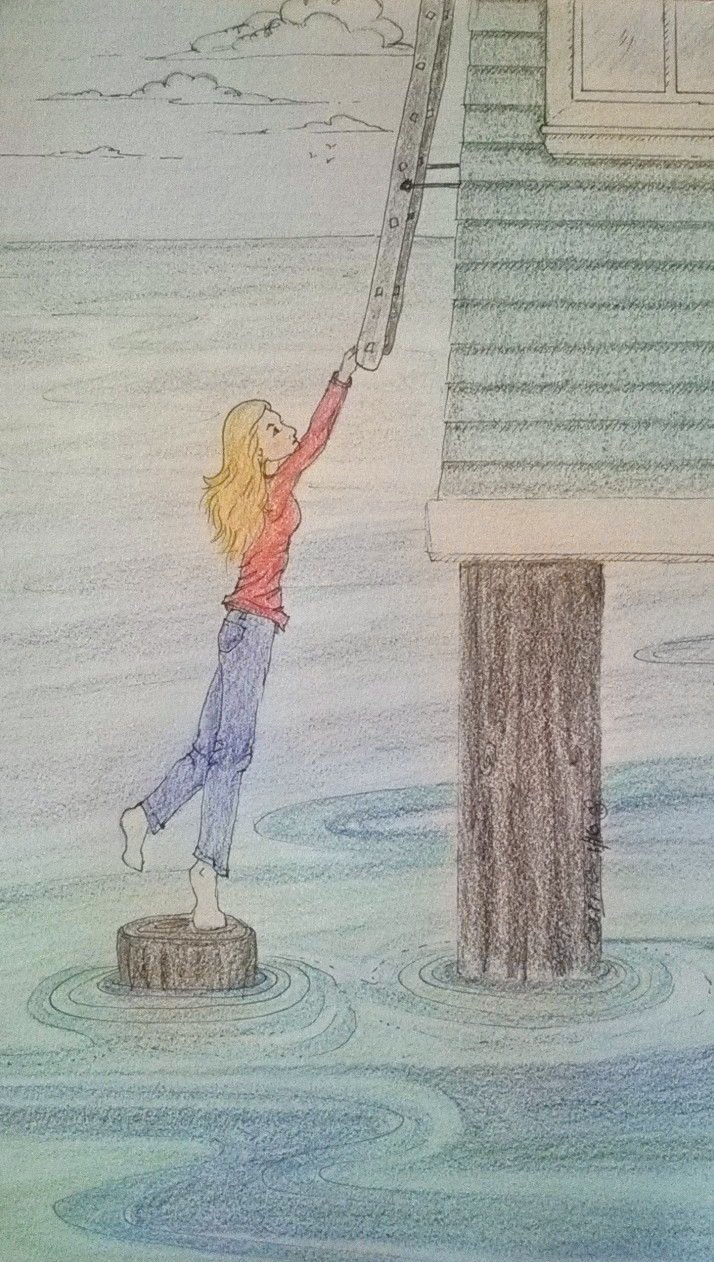
This is no easy task, my attempt to re-enter the house. It sits high upon thick wooden pylons sunk deep into a body of water that stretches out toward the horizon. I stand on a squat pylon similarly anchored, but one that is far too near the water’s level for comfort. Wavelets splash against the pylon’s coarse sides, sending sprays of moisture to dampen my feet.
Extending down the house’s side, and just beyond reach, is a narrow fire escape. Standing on tip-toe, stretching till there is no space in my lungs for breath, I brush fingertips against the ladder’s lowest rung. Another breath, another attempt. Again. More length, more extension — and I am able to wrap fingers around the rung. Now, I haul myself up, inch by inch, sweating, straining, heart hammering in chest and temples, until I have exchanged the pylon’s questionable refuge for that of this fragile fire escape. The structure shudders quietly against the house.
Once I’ve caught my breath, I climb. The waters recede below with each upward step; the wind pulls and plucks. Gradually, the fire escape transforms into a series of railed gangplanks and suspension bridges that rise steadily upward about the house, switching back and forth to weave a scaffold framework around the entire structure. When, at last, I reach the top, I enter the house through a narrow window in a peaked turret.
But my climb is not over — now, I descend the house’s interior by a continuation of gangplanks and narrow floating stairs. These pass through a multitude of oddly-shaped, warmly-lit bedrooms. In one of the rooms I pause — there is a young girl here of about twelve years old. At first, she seems oblivious of my presence. But when she turns toward me, she smiles and we spend time chatting amiably. Although I know her immediately, she does not seem to recognize me. Perhaps because I am somehow in my own past, or hers, or ours. I don’t know how timeline logic works. The reality is that here and now, at this moment as we speak, she has no memory of the fact that we haven’t spoken in so many years, almost as if it never happened, or hasn’t happened yet.

Soft moss and rosettes of lichen embroider the pebbled bark of this young dogwood.
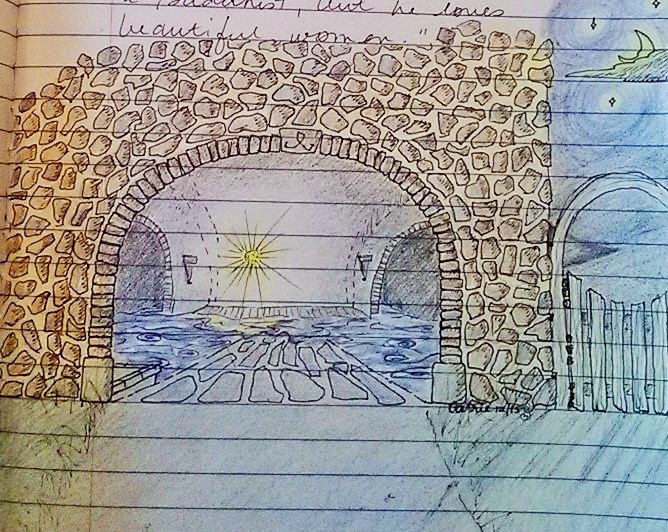
At some point in its past, this old, fieldstone structure may have been a fortress. But now, it is the site of a haunting, and we three have been called to investigate. We approach carefully, picking our way through night-drawn shadows over the grass-edged dirt road. The building’s open arch gapes just ahead. Wide, flagged slates sweep steadily down into the fortress, which is filled with dark, stagnant water. Just within the entry, a stone ledge dodges off to the left — water laps and splashes against it, but the ledge itself remains dry. One of our party follows this narrow path; I and our third member proceed down the slope of slates toward the murky interior.
The drip of water pierces muted dark; peculiar lights and reflections add a random pulse. Suddenly, a fist-sized bright light pops into existence and zips toward our solo party member, where it pauses, hovering before his face. Then, it zips over to hover similarly before my own — its light is so bright, I must squint against it, drawing my arm up to shield myself from its intensity. Finally, upon visiting the last of our party, it soars away, deep into the castle, down a watery corridor.
For a moment, all is dripping, lapping silence as we stand breathless, waiting for our vision to readjust. Another noise emerges now, off to the right. I see, beyond the window-pierced stone wall, a figure passing by outside, its movements furtive, suspicious. Dashing back up the sloped flags, I move to intercept. An arch-topped garden gate is affixed to the fortress’ side here, and I wait beside it, patiently. The click of the gate latch, the sawing hiss of wooden boards against untrimmed grass as the gate opens…
To my astonishment, a tiny man steps through. He’s no more than three feet tall and about sixty years old, with a wispy fringe of white hair. Though he is unusually small, he is perfectly proportioned, a perfect miniature; he carries in his arms a similarly scaled violin and bow. Upon seeing me, he starts in surprise, equal to my own. But I realize…I know this man! It is Mischa Elman, the violinist famous for his passionate style and tone and musicality! All thoughts of ghost hunting vanish in my excitement to meet this man. Graciously, he shakes my hand, pulls from the vest pocket of his dark suit an old creased and faded blue program. It lists all the songs her performed live in concert in 1957.
Note: Mischa Elman truly was a gifted violinist. Born in the Ukraine in 1891, his family moved to New York and he became a U.S. citizen in 1923. He died in his home in Manhattan in 1967 and is buried in the Westchester Hills Cemetery, NY. So much was his playing admired, he sometimes performed as many as 107 concerts in a 29-week season. He was not peculiarly small.
I dreamed I stood with my back to Autumn on the eve of Winter, and though I called out, I could not be certain my voice would carry over the noise and clamor of shortening days and encroaching dark.
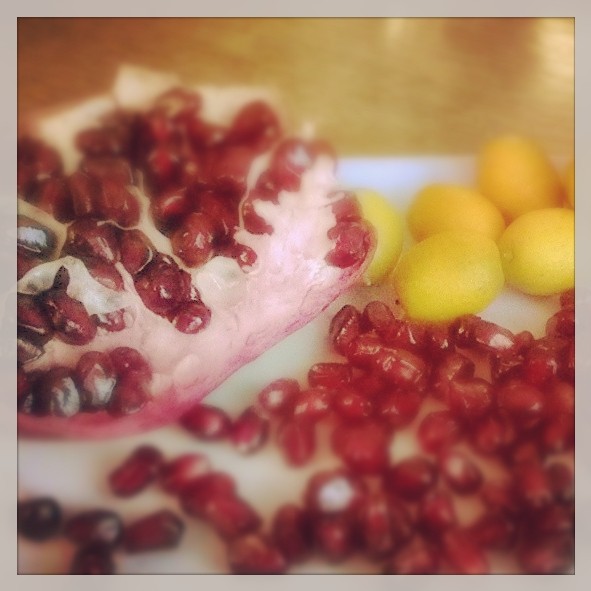
Despite the graying cold, we threw open the doors, and the house filled with warmth. Cheer and laughter and conversation wove a skein, each thread a shining filament kindled in our hearts that lightly bound us all. We broke chocolate together, and ate sweet-tart kumquats, and swallowed crimson pomegranate seeds. We sipped effervescence and lit the evening with a pale, warm glow that warded darkness.
Scattered about, I found unexpected tokens — owls of wisdom; a likeness in powdery charcoals; tiny cakes; words and raven linked by slim chain; a soft beam of sunlight; edible spells bound in paper; and a tiny, shining, golden dragon.
We parted with smiles and embraces; but the warmth — now fed and strengthened — remained. A dream come true.
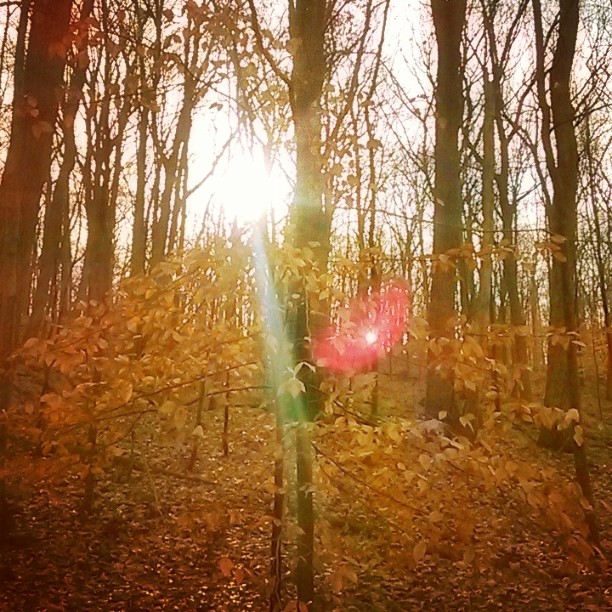
I am fortunate this creature found me intriguing enough to make her presence known, and elated she allowed me to photograph her. We sat together a moment, amongst the leaf-fall and gilt trees, sipping cold, sweet dew from acorn caps while admiring the advancing morning’s play of light and color. Then, without a word, she vanished. Sprites are mercurial that way.