Before she can retrieve anything from that once-home, sunlit room, they have picked, like vultures, through her few possessions. The veneer cracks — all kindness, gone. Angry, she shouts; anguished, she chastises, drives them off. But there is nothing left — collapsed and sagging cardboard boxes. Scuffed floors. The smell of dust.
Turning away, she walks unshod, out along the curving road’s edge, heedless of night and cold and snow. Cars pass infrequently. Predatory, lazy, sated, their headlights melt through darkness, veer toward her, then jerk away. Heart racing, she hides behind scrub and winter-knotted trees when they pass. Until, she realizes she has no need to walk this night-swallowed road…
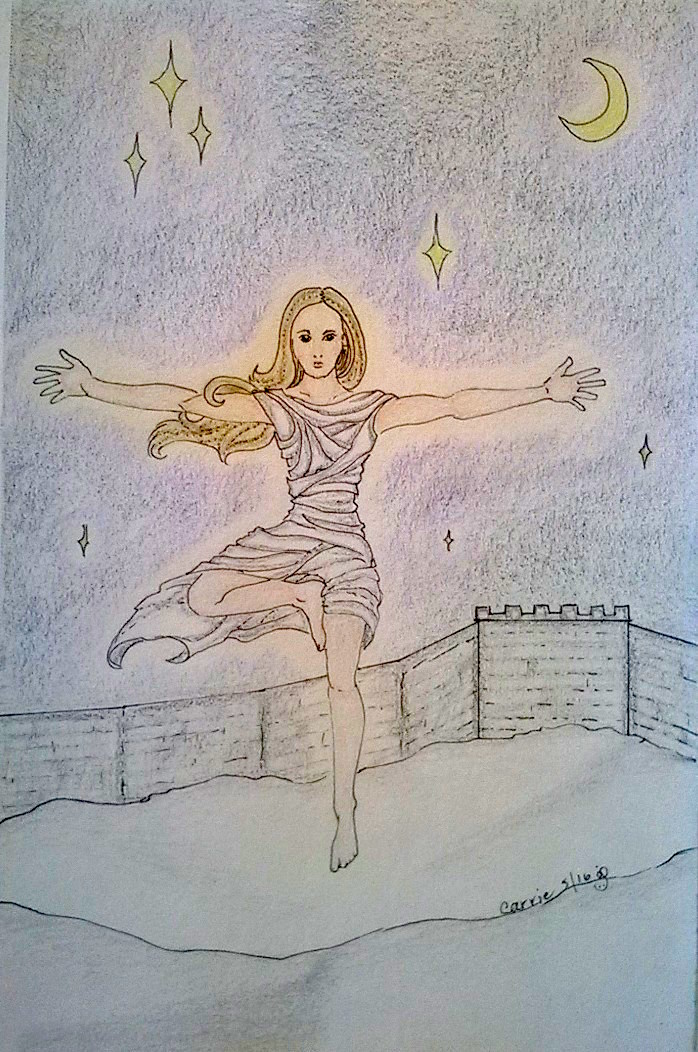
…and lifts from the snow, abandoning her stumbling footstep’s impressions. Rising, now, three feet above the earth, four feet, she moves through the night, slides through frictionless air. In tight revolutions, she begins to spin along the axis of her spine. Arms outstretched, one leg drawn up and crooked against the other. Spinning, hovering, calmly progressing forward, away over snow-bound earth.
Below, a crush of people push through the snowscape, too exhausted, too single-minded in their march to pause, to glance about. Observing one among their numbers falter, she slows her spinning motion to alight in the snow. This one is gravely wounded, and, ignoring the fallen one’s protests, she presses hands to either side of, then lips to the injury. Beneath her touch, bruised and broken ribs knit, raw flesh heals. The once-injured individual leaps up, rushes to rejoin the marching throng.
Having landed — feet earthbound, spinning stilled — she steps away from the human river to enter a sandstone house, seats herself within a small chamber. Bead-curtained walls glitter, defining the space in light and color. Now and then, individuals leave the never-ending march to visit. She tends to each — healing bodies, settling hearts, soothing minds — until, her kindnesses suspected, she is once more…
…evicted.
No shouting, this time. No chastising. Agreeably, she leaves the little house and resumes spinning levitation. The snowy plain unfolds beneath her, bounded on one side by a great stone wall, thirty feet tall and twenty feet thick. Following the wall’s contours, she rises steadily, gradually achieving sufficient height to land on a square, bare terrace entirely free of snow. Otherwise unreachable — no stairs lead to this space, no doors open onto it — she touches down within the spread of worked stone. She spins no more. She has arrived.
Sleep lifts slowly, receding with the reluctance of a high and heavy tide. Don’t know what has awakened me, but feel something — a looming presence, an other.
Half rise, propped on one elbow. Blearily, sweep eyes about the room, attempt to peel back semi-dark, to see. Lamp on the nightstand, beside the leaning stack of books; low bookshelf, crowded with more paper spines; dresser squats in the corner, pressed against the wall. And then…there…standing in the doorway…
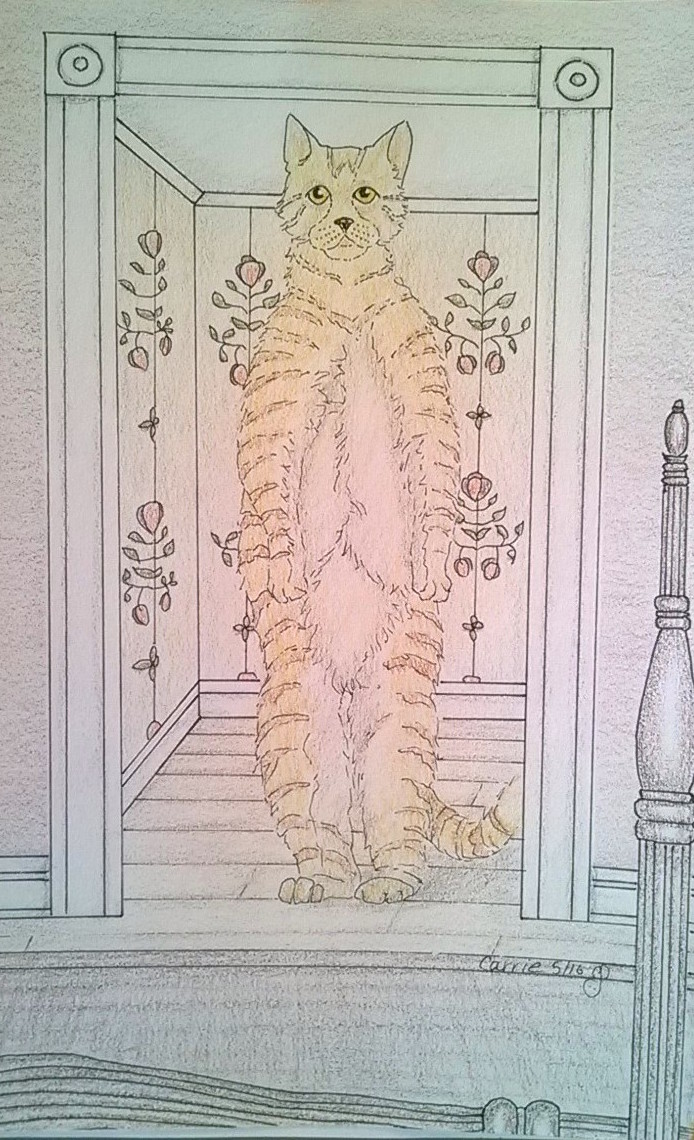
So tall…taller than logic, than thought or reason… A six-foot tall expanse of ginger… Haven’t seen him in years, since he died, in fact. But even then, in life, don’t remember him being so tall. He fills the doorway. Unblinking. Silent. Which should not surprise. Cats rarely speak.
I could tell by the look in her eye, these were precisely the wrong words. I knew that look, had seen it before. She had worn it at least once a day throughout her handful of twelve years. And I — being older, arguably wiser, and having experienced her moods — should have known better.
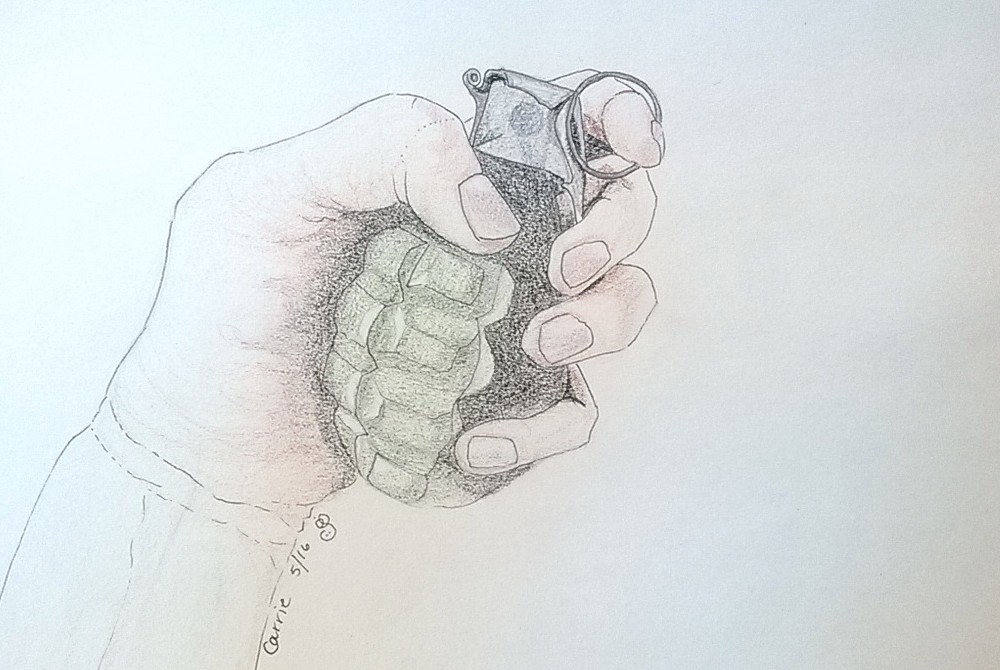
For a moment, her grip on the grenade tightened, white-knuckling her small fist. I felt the vacuum of her scrutiny.
She pulled the pin.
Great.
“Now, you’ll have to keep your finger over the trigger to interrupt the count-down.”
When will I learn?
“Follow me.”
I must find some place she could release the grenade, hurl it as far from her — from us — as her skinny tween arm was able. Despite this — the fact that she’s willing to blow us both to pieces — I feel surprisingly calm.
Just ahead leans a great dilapidated structure. A ramshackle, run-down barn, walls and roof sagging, groaning toward center. Pushing open a door, I lead us inside. The barn reeks of abandonment; dusty shafts of light leak through cracks and seams. Piles of junk crouch in shadows — boards and beams split and broken, pricked with bright and rusted nails; broken chairs; moldering carpets, rolled in upon themselves; ancient, derelict equipment.
“Keep close.”
Past heaps and shifting stacks arranged in makeshift aisles, I lead a careful, winding route, locating, at last, a set of huge, sliding doors, limned in dim light. Hip and shoulder pressed to wood, hands gripping the door’s rough edge, I push, push against the door. Slowly, it scrapes open far enough to allow exit.
Outside, dusk has fallen. A great, green field rolls beyond the barn, spilling gently away to a flowered field. Daisies and bluebells.
“Okay,” I tell her, “now, throw it — as hard as you can.”
Turning to glance behind me — to encourage, exhort, cajole — I find myself alone. She didn’t follow.