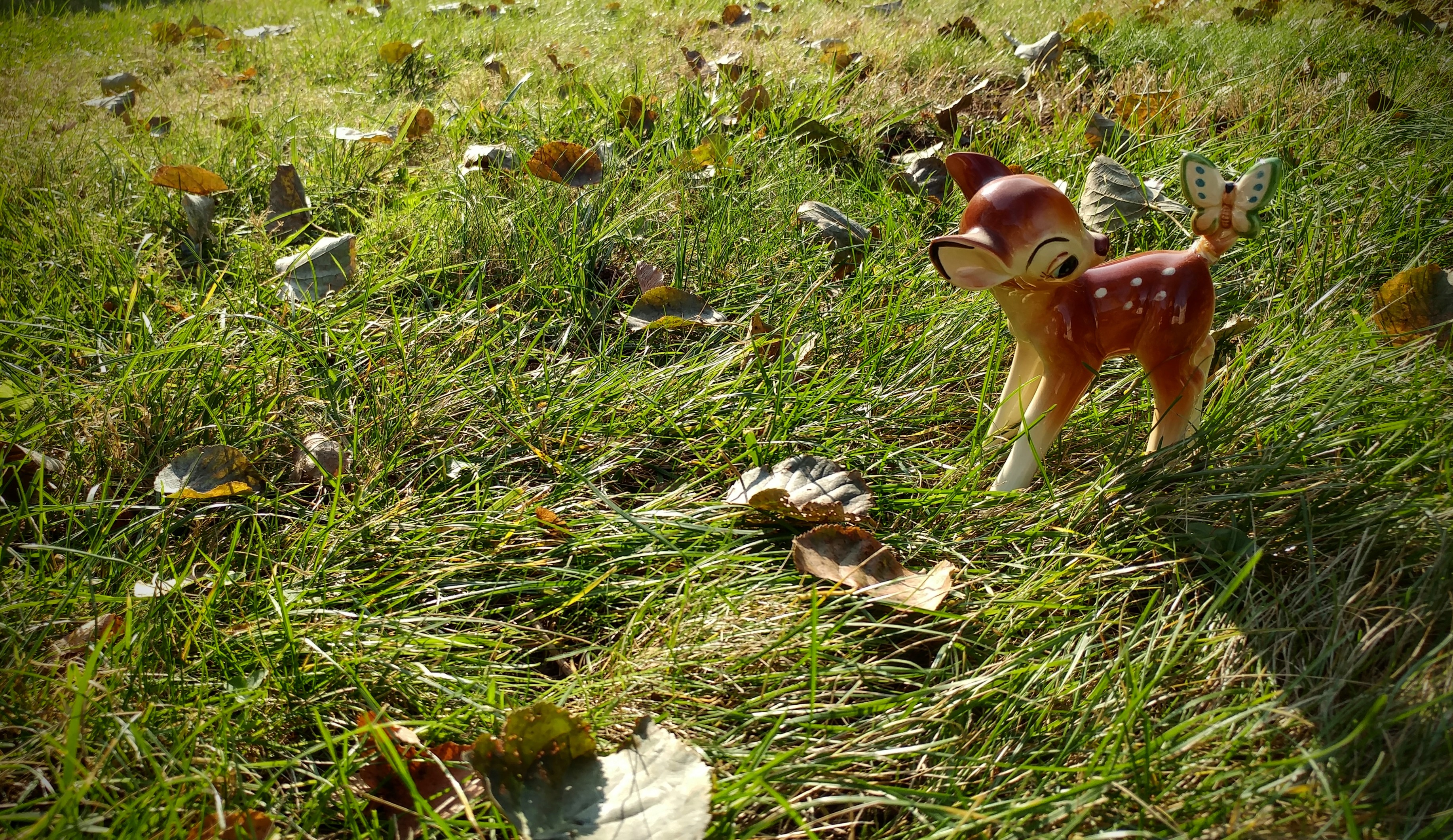
A mere twelve inches at the shoulder, fourteen inches in length from chest to tail, it is the smallest of white-tailed deer. And so young – its tawny coat is sprinkled with white dots. It stands on impossibly slender legs. With a flick and flash of its tail, it gathers together its tiny hooves to leap and prance and dart about. For sheer joy, it cuts reckless, random patterns through the swaying meadow, beneath the dividing shade of towering trees.
At last, it pauses – gawky legs spread and anchored, tail raised, ears alert – an arm’s length away. Reach out to stroke it, to feel the silken fur stretched over that delicate structure of bones; to feel the small knob of skull, that firm reassurance crowned in large, fur-fringed ears.
Away. Away.
Fleet as forethought, the fawn leaps beyond reach, dashes in mad circles through wind-blown grasses. Scissoring through wildflowers, it cuts back and forth in indecipherable movements. Upon reaching the base of a great, thick oak, the deerling whisks up the tree’s grooved trunk. Tiny hooves serve as pitons fitted to the bark’s cracks and fissures.
Hand’s edge raised to shield your eyes, lean back, squint to follow its wild movement. Spy a flash of auburn within the canopy overhead. Hear the scrabble of its hooves against trunk and branches. Catch the sift and fall of loosened bark against your upturned cheeks, chin, lips. Feel a fist-solid pressure rise beneath your breastbone.
Beyond the plate-glass doors, in dim half-light, sheets of paper lay strewn about the floor – slim sheaves spread in a white drift over flecked linoleum.
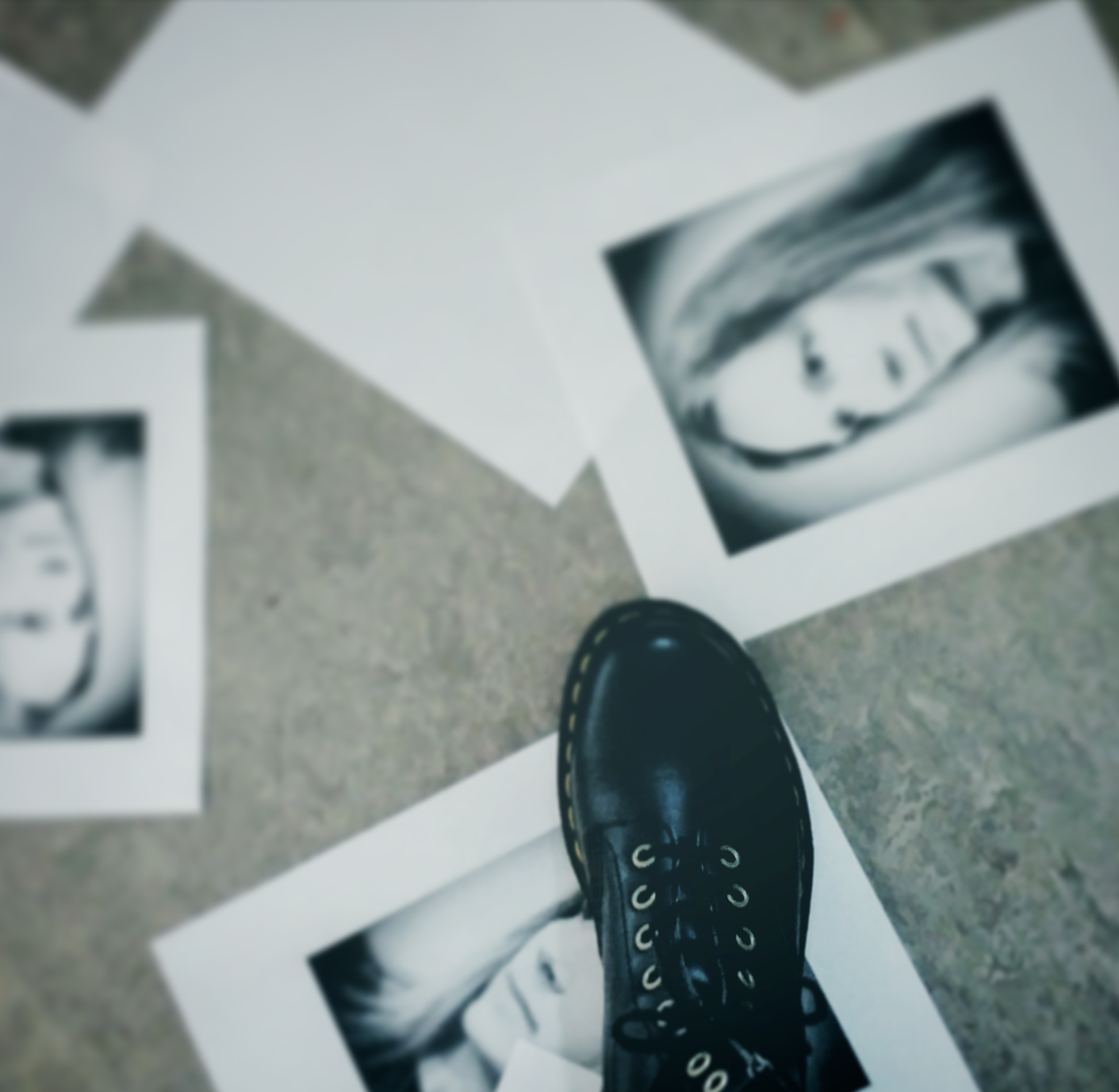
The woman placed her hand on the door’s bar – a leather-softened grip fastened over a horizontal tube of buffed aluminum. Depressing the handle, she entered. Pale light flashed and lanced off the door’s glass. Once inside, she paused, adjusted netted top hat over the knot of her hair, tugged velvet jacket into place over her ribs so brass buttons aligned spine-straight. When she broke, once more, into movement, tiers of crisp taffeta shushed about her legs. The clip and snick of her boot heels echoed, their insistence blunted by the path of paper underfoot. Each thin leaf she trod held, trapped within its rectangle, a black-and-white headshot of the shaming victim. Unwavering, the woman followed that paper trail.
When the entry hall widened, the woman halted her march, reached behind herself to lift and agitate her skirt’s bustle. The action loosed an additional sheaf of papers — they drifted free, curled in the air and settled gently to the floor behind her. These, too, held black-and-white headshots, trimmed of excess paper about the victim’s tumbled hair and shoulders.
Unsmiling, the woman continued down the hall.
Shush, snick – heel against throat. Shush, snick – toe filling mouth.
Side by side that night, we slept and dreamed our separate dreams.
Or so it seemed.
I, in a derelict house that leaned within its footings, climbed a crooked staircase through a murk of dark. Hand trailing the banister’s time-gnawed and pitted wood, I reached the slanted landing and moved, as if down a throat, through railroaded rooms that lead one into another. Faded carpets underfoot, their colored patterns lost to time and wear. The house felt empty – of soul and memory – and the walls held little on their broken plaster planes beyond strips and tears of antique floral papers. Three windows in that final claustrophobic room held only night – far darker for its starless aspect – and here, carpet and floorboards both peeled and fell away to reveal a swollen bulge beneath. The sides sloped gently upward to a hole defined by the floorboards’ split and broken edges, and from this broke-toothed fissure emerged a skittering, chittering fury of insects. Mandibled and multi-legged, their pale, foot-long, segmented bodies writhed in and out of that misplaced hole in chaotic, threatening fashion. Near at hand, I found a smooth, stout branch and thrust its gnarled end into that revolting hive. I heard the crunch and squish of squashed, insectoid bodies, felt my stomach heave. But the swarm did not decrease. I knew I’d earned the creatures’ wrath when, with relief, I woke.
Unbeknownst to me, he, too, in his sleep dreamed. Of a house, filled less with dark than light, its angles meeting square and right. And he – downstairs, not up – perceived in the sweep of ceiling overhead a bulge in that smooth space, seemingly benign. A squat stalactite of sloped sides, its peak crowned in a dark, hollow depression from which moved to and fro a collective of insects, sleek bodied with wings of pale and iridescent green pressed to the subtle gleam of their hardened carapaces. Though he craned his neck to discern the meaning of their movements, he felt no threat, but curiosity.
Side by side that night, we slept and dreamed our separate dreams.
He is hired to get close to people, to win their trust, put them at ease. But it hurts. Hurts to witness. The casual touch – his hand brushing her shoulder, placed at the small of her back; his smile – a brightening of the eye, a flush of skin – returned.
Turn away. Let them dine on candlelight and wine. Let soft light travel over turned silverware, along the rims of glasses raised and tipped; down her long neck, the sweep of her collar bones. He does not love her. But it hurts.
It hurts.
Turn away. Leave them. Steal off, down the length of hall. Recede into shadow, into self. Reach the door, that worn and featureless divide. Twist the well-burnished knob. Enter. Lean against the closed door, spine to wood. Survey the room, unseeing.
A Spartan space. Bare wood floors. Neatly made bed, spread with white needlepoint cover. Aged, wooden dresser. One square curtainless window, set too high in the wall opposite the door. Unrestricted moonlight paints the floor – four squares of parted light.
Push off the door. Cross to the room’s center. Drop to knees. Insert fingers along the floorboards’ seams, and peel. Peel them up and away, layer after layer. Narrow planks curl backward upon themselves, until they reveal their secret – the space below; the neat cardboard box within.
Grip the floor’s edges. Place one foot down, inside, then the other. Lower knees, hips, ribs, shoulders. Slip into that square hollow. Curl up in the dark, knees to chin, and pull the floorboards closed, back into place.
Later – later – hear the doorknob rattle, the squeak and scrape of hinges. Hear him call. The pain in his voice — the quavering upswing. His heels pace circles against the floorboards above. Back and forth. Round and round. Calling.
Driving. The road ribboning out ahead, onward. A blur of green trees to the left, cool with shadow, leaves rustling. To the right, open fields echoing the trees’ green pulse.
— She found them in her yard.
The car’s open windows gathering his words; spreading, elongating, lifting them away.
— Two fawns. The mother never returned for them.
On the right, in the distance, a low structure resolving. Beyond the field’s edge – a café. Bright white flash of walls. Glassless window casements stretching from foundation to roofline. Over the low wall, a fawn leaping out one of the wide-open casements. Stick-thin legs extending over grass, bunching, and tangling. The fawn collapsing – an angular heap of pale rust fur within the field.
Crunching of tires on gravel. The car pulling over, stopping on the shoulder. Opening the door. Jumping out. Running across the field, legs eating up ground, arms lifting. Outwards. Toward the fawn.
Don’t be dead don’t be dead.
A woman exiting the café, reaching the fawn and scooping it up. Cradling it in her arms; the fawn, struggling, kicking.
Arriving, breathless, beside them. Noticing, over the woman’s shoulder, the second fawn inside the café, standing on a bistro table.
— So wonderful that you’ve saved them!
The woman stroking the fawn’s narrow skull. The fawn, laying its head against her shoulder, against the spill of her dark hair. She, kissing its forehead.
— It was the only choice.
The woman turning, walking back to the café, setting the fawn down near its twin; draping her arms over each.
Following. Entering the windowed/windowless building. Approaching the table, and the woman, and the fawns. Observing all three slowly turning. Seeing the fawns’ faces clearly. Gasping aloud. Staring at those flat, identically stamped oval faces.
The creatures staring back – fawns with the faces of sober young girls. Ringleted hair tumbling to either side of their large, tufted, twitching ears.
In the distance you see her – skirts clutched, she stumbles toward you, through the vast cavern. Far above, the ceiling collects and spreads darkness. But a vague luminosity of indefinite source slides over her form as she runs. This pale glow gathers in the folds of her dress, defines the wayward strands of her hair. Observe — the knot of hair at the base of her neck works loose.
Catch her, as she collides into you. Feel her shoulders convulse as she weeps into her hands. Sense her exhaustion, her heartbreak. Hear the tumble of words pour from her lips.
Listen — to her sad story. Of drama, deception, heartbreak. Of the man she had loved, had devoted herself to. See, as she speaks of him, his image grow in your mind – a tall man, regal in bearing, a cascade of bright black hair. Dressed in antique style, in blue surcoat and white lace cravat. Wonder how she could not have seen the arrogance, the cruel calculation in his eyes, how she could never have suspected. Oh, but she knew now. When their son reached 15 years of age. Then, she learned. The ugly truth. That she would be drained entirely of blood to sustain the boy, that her whole purpose had never been otherwise.
So she had run. Escaped. And now, feared endless pursuit.
Accept her head within the curve of your neck and shoulder. Accept her sobs. Embrace her. Hold her tight, steady her as her body wracks with spasms. Take her narrow hands in your own, and lead her from the road, away, to the field of chrysanthemums. The flowers bloom in a grid of formal lines and rows. Bright clusters of yellow, earthen amber, pale lilac, crimson, pearl-washed moonlight. Draw her down beneath the petalled rays, beneath the leathery green leaves. Kiss her once – lightly, gently. Swim with her, along the tilled earth. Through miles of sheltering blooms and leaves, as your skin collects the flowers’ perfumed breath.
Swim with her, safe from harm, free of discovery, beneath the flowers, in the subterranean, chrysanthemum sea.
Tethered one-to-another by flexible, gray tubing, each hangs suspended in space like a great dish; floats, like a flattened bead strung along a cosmic necklace. Deep, inky-dark, vast, star-pricked space surrounds, but travel between the flat worlds is possible by way of the tubes. Slide through them – a whoosh of air, a thought – and arrive at your destination on another world that extends, equally flattened, edge to edge, and scrapes against unprotected space. No walls. No railings. No net below to catch any misstep. Yet there is air – lungs expand and contract easily, naturally. There is gravity – the surface underfoot gently accepts and repels each stride. And each flattened world glows softly with gathered, reflected light. See them shine; beacons within a nameless constellation.
All is perfectly ordinary…except for the door.
A reinforced storm door rises, monolithic, from an embankment of silt-gray earth and stone. Twin horizontal lengths of orange metal. No sun-kissed citrus shade; but a dull throb of sullen color. A warning. A threat. It both draws and repulses. And does it – beyond its fierce, featureless slab – protect, or imperil?
Singly and in pairs, they arrive — men and women, dressed in jewel-toned satin and velvet gowns, in embroidered cravats and dark silk tuxedos. They sweep into the ancient, compact castle — more of a turret, in truth, or a fortress. Clustered in small knots about a great length of dining room table, they bloom against the bare, gray stone floor and walls. Soft conversation flickers with candlelight.
But their arrival is earlier than expected. Unprepared, shake each proffered hand. Kiss signet rings, the backs of smooth wrists. Return each smile, each warm greeting. Hear not one comment, nor one remark regarding disheveled hair, tattered clothing, unwashed odor. Surely, they notice. Kindness stills their tongues; propriety.
At last, the number of arrivals diminishes, ceases. Slip away. Slowly, back towards the small door, that ellipse of wood within stone. Quietly, quietly — ease the door open. Steal through the narrow fissure to enter a small, round stone chamber. Softly, pull the door shut. Lean against it.
Spread across the chamber’s floor — rumpled and crumpled and imbued with blue shadows — is a great sweep of strewn white cloth. To the left of the closed door, a stone staircase sweeps upward, follows the tight curve of the turret’s exterior wall. Set foot on the bottommost step. Notice the white cloth shiver and move. A kitten – small, gray-and-white, with the short stand-up tail of the newly born — wriggles out from the fabric’s folds. Mewing, comically determined, it follows along behind, up the steps.
Climb. Five steps. Six. Seven. With the kitten directly behind. See, at eye-level on the steps ahead, a frantic blur of yellow motion. A fledgling canary with curiously long feathers. Scoop the bird up – out of the kitten’s reach. Feel the brush of soft feathers, the tick of small talons against skin. Watch the canary lift up, flutter out and away. Its extraordinarily long wing- and tail-feathers flow like ribbons of sunlight. Over the kitten. Down the steps. To safety.
Continue climbing. Arrive at another small, wooden door. Push. Beyond it, find a circular room with high-vaulted ceiling. White porcelain sink and toilet and bathtub gleam against gray stone walls and floor. A single window stares out into darkness. Across the room, a narrow, arched doorless exit leads down a corridor… Cross the room. Step into that arch of stone-darkened throat. Set hands on a small gate, draw it out from the wall — a makeshift barrier that will lend privacy to the bath.
Again, movement. There, further down the corridor, emerging from the dark — a tall, trim man. Dressed in soft brown tweeds. A bulge beneath his jacket and vest. Approach carefully, step toward him. Peer — curious, eyes squinting — at the lump caught gently, safely against his breast, buttoned up beneath the tweed vest. See a small, smooth-feathered crown; wide gold eyes within a heart-shaped face — a barn owl.
Listen as the man explains: Out on the darkened lawn, far below the castle, five shapes lay motionless as shadow. Each a barn owl — four young, one adult. All but he had passed by, oblivious. None but he had taken note, gone to investigate. Had found one young owl alive amongst the five.
From the deep vee opening of the man’s vest, see the barn owl blink. Smitten, reach out. Stroke the smooth, white-feathered head. Feel the sharp clench and wrench of heart.